October 2 Protest Explained: Why Are People Protesting, What Are Their Demands, and What Happens Next?
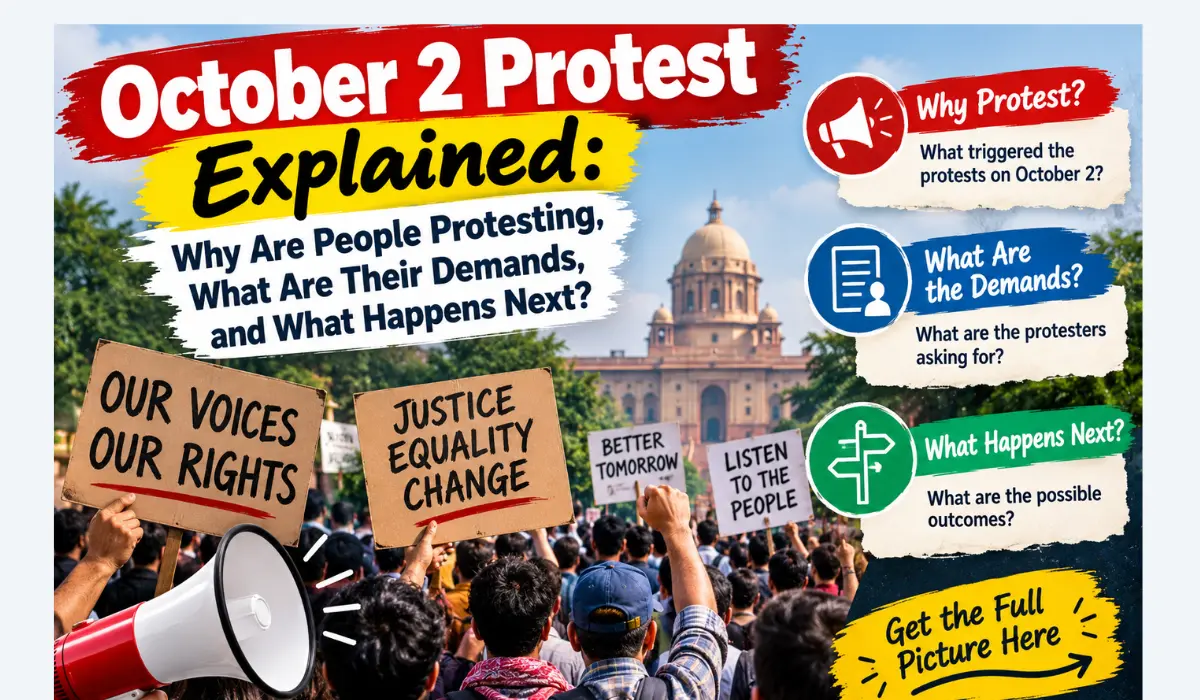
From October 2 to October 8, 2026, the Opposition INDIA bloc is holding district-level “Save Democracy Marches” across India, with a separate protest planned in Mumbai by a smaller group, the Cockroach Janta Party (CJP). Both are driven by the same underlying row — allegations that the Election Commission of India (ECI) is mishandling the Special Intensive Revision (SIR) of electoral rolls. The Opposition calls this alleged mismanagement “vote chori” (vote theft). The BJP and the Election Commission reject the allegations and point to a Supreme Court verdict in May 2026 that upheld the legality of the SIR process. Here’s the full picture, in plain language.
What’s actually happening on October 2
Two separate but related protests are planned around October 2, 2026:
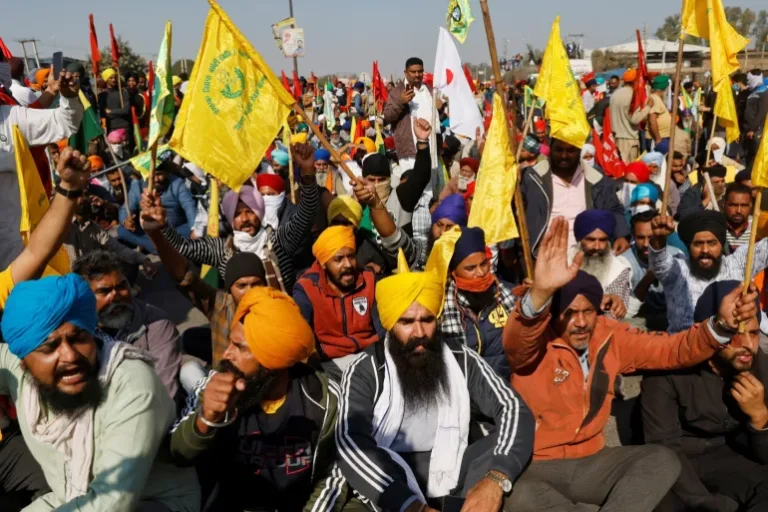
- INDIA bloc’s “Save Democracy Marches”: Announced after a nearly four-hour coordination meeting of Opposition parties in New Delhi on September 30, Congress president Mallikarjun Kharge confirmed that INDIA bloc members will stage protests at District Magistrate (DM) offices across the country from October 2 to October 8. On October 6, Opposition MPs will march specifically to the Election Commission’s office in Delhi.
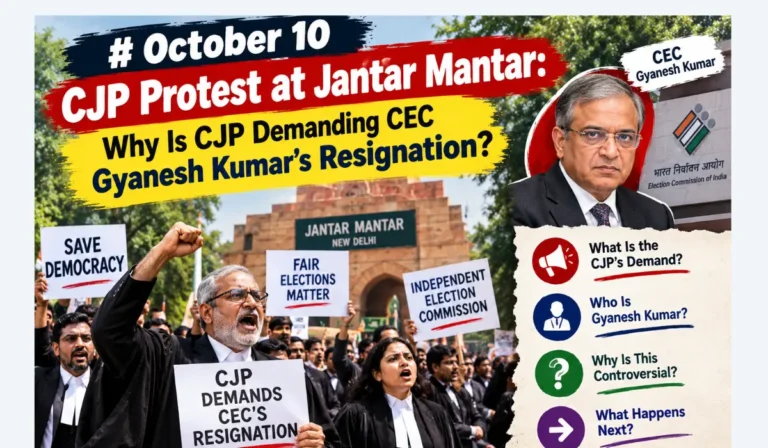
- CJP’s Mumbai protest: A separate, smaller civic group called the Cockroach Janta Party has announced its own October 2 protest at Shivaji Park in Dadar, Mumbai, specifically demanding the resignation of Chief Election Commissioner (CEC) Gyanesh Kumar. The group’s convener, Abhijeet Dipke, has said Mumbai Police denied permission for the protest, and that the group will launch a “Jail Bharo Andolan” (fill-the-jails movement) if the denial stands.
Both protests are scheduled around Gandhi Jayanti (October 2), a date widely used in India for civic and political demonstrations because of its symbolic association with nonviolent protest.
Why are people protesting? The root of the row
At the center of both protests is one issue: the Special Intensive Revision (SIR) of electoral rolls, and whether it’s being carried out fairly.
What is the SIR, in plain terms?
The SIR is a door-to-door, large-scale re-verification of India’s voter lists, carried out by the Election Commission under Article 324 of the Constitution and Section 21(3) of the Representation of the People Act, 1950. Unlike the routine annual revision of voter rolls, an SIR involves enumerators visiting homes, distributing pre-filled forms, and in disputed cases, asking voters to prove a link to an earlier electoral roll. The ECI’s stated reason for conducting the current SIR is that more than two decades had passed since the last full intensive revision, and that large-scale migration, duplicate entries and outdated records had accumulated in that time.
The current SIR began in Bihar in mid-2025, ahead of that state’s assembly elections, and has since expanded into a second phase covering nine states and three Union Territories, affecting roughly 51 crore (510 million) voters, according to reporting based on Election Commission data.
What are the Opposition’s specific complaints?
The Opposition’s core allegation, which Congress leader Rahul Gandhi has repeatedly described using the phrase “vote chori” (vote theft), rests on a few specific claims:
- That the SIR process has led to large-scale, wrongful deletions of eligible voters from draft rolls — reports cited by the Opposition and some media put the figure at more than 13 crore (130 million) names removed from draft electoral rolls across 30 states and Union Territories during the exercise, according to an Indian Express report cited widely in subsequent coverage.
- That the process disproportionately affects marginalised, poor and migrant voters who may struggle to produce the documentation needed to prove continuity on the rolls.
- That two of the three Election Commissioners, Sukhbir Singh Sandhu and Vivek Joshi, recorded formal objections at least 14 times over 10 months to SIR-related decisions, according to Indian Express reporting that triggered the latest escalation. The commissioners reportedly said some directions were issued without their knowledge or recommendation.
- Former Chief Election Commissioner O.P. Rawat has also publicly questioned aspects of the SIR process, telling The Hindu that the scale of eligible voters losing voting rights was, in his assessment, unprecedented since Independence — though he also noted the two objecting commissioners held a majority and could have formally voted to overturn decisions they disagreed with, since the CEC has no veto.
Kharge has also raised a broader institutional concern, saying democratic institutions are being weakened and alleging that the Election Commission is functioning under government influence — a claim the BJP and the EC strongly dispute.
What are the Opposition’s specific demands?
Based on statements from Congress and INDIA bloc leaders, the core demands include:
- A rollback or freeze of the ongoing SIR process, pending what they describe as a transparent review.
- Restoration of the January 2025 electoral rolls, as a baseline the Opposition considers more reliable (this is specifically a CJP demand, echoed in broader Opposition messaging).
- Accountability from CEC Gyanesh Kumar, including calls from Kharge and others for his resignation, framed around the internal objections raised by the two other commissioners.
- Greater transparency in the SIR process, including questions about why CCTV footage from polling stations is deleted after 45 days, and calls for access to Electronic Voting Machine (EVM) architecture.
- Reform of the law governing the Election Commission, including the 2023 law on the appointment and removal process for the CEC and Election Commissioners, which the Opposition argues reduces institutional independence.
- A formal meeting with President Droupadi Murmu in the second week of October, to raise these concerns directly.
What does the other side say?
This is a genuinely contested issue, and the government, the BJP and the Election Commission have pushed back firmly on each point.
The Election Commission’s position: The EC has said that differences of opinion and comments during internal deliberations are a normal part of institutional decision-making, and that every officer of the Commission is authorised to offer suggestions — framing the objections reported by the two commissioners as part of routine functioning rather than evidence of wrongdoing. The Commission has also stated that all its orders carry full legal sanction and follow established statutory procedure. Earlier in the controversy, at a press conference, the CEC rejected allegations of double voting and “vote theft” as baseless, and asked Rahul Gandhi to submit a sworn declaration on his specific claims within seven days or have them treated as baseless.
The BJP’s position: BJP national spokesperson Sambit Patra has rejected the “vote theft” framing entirely, arguing that elections have been conducted smoothly in India since 2014, and pointing out that the final SIR decision was reached with unanimity among the Commissioners. Union Home Minister Amit Shah, responding to the allegations in the Lok Sabha, said the SIR exercise was intended to “detect, delete and deport infiltrators” from the voter rolls, and turned the “vote chori” charge back on the Congress with historical references of his own.
The Supreme Court’s position: This is the most consequential fact in the dispute. On May 27, 2026, a two-judge Supreme Court bench of Chief Justice Surya Kant and Justice Joymalya Bagchi delivered a 124-page judgment rejecting a batch of petitions that had challenged the SIR’s legality, including petitions filed by the NGO Association for Democratic Reforms. The Court held that:
- The Election Commission has the constitutional power to conduct an SIR under Article 324 and Section 21(3) of the Representation of the People Act.
- The exercise has a “direct nexus” to the constitutional goal of free and fair elections, and cannot be invalidated simply because it departs from the ordinary modalities of a routine revision.
- The ECI’s stated reasons — the long gap since the last intensive revision, large-scale additions and deletions over the years, and the effects of urbanisation and migration — were legitimate justifications.
- Procedural safeguards such as notice, hearing, objections and appeals were preserved, and during the hearings, the Court had already pushed the ECI to add Aadhaar as an additional acceptable identity document and to publish the names of voters added to the final rolls.
It’s worth being precise here: the Supreme Court’s verdict settled the legal question of whether the ECI has the authority to conduct an SIR — it did not rule on, and does not resolve, the separate political dispute over how individual deletions were handled on the ground, or the Opposition’s claims about internal Commission disagreements, which emerged in media reports after the verdict. Several legal commentators have noted that the judgment “settles the legal question of constitutional authority but leaves unresolved concerns on absence of due process,” referring to ongoing disputes over specific voter exclusions.
A quick timeline of how we got here
| When | What happened |
|---|---|
| Mid-2025 | ECI notifies the first phase of the SIR, starting in Bihar |
| Late 2025 | Bihar SIR concludes; electoral roll changes from roughly 7.89 crore to 7.42 crore voters (a net deletion of about 47 lakh names), according to Election Commission data reported in current-affairs coverage |
| October 27, 2025 | Second phase of SIR begins, covering nine states and three Union Territories |
| January 29, 2026 | Supreme Court reserves judgment after hearing petitions challenging the SIR |
| May 27, 2026 | Supreme Court upholds the legality of the SIR in a 124-page verdict |
| September 2026 | Indian Express reports that two Election Commissioners recorded 14 objections over 10 months; Rahul Gandhi and Congress escalate “vote chori” allegations; BJP and EC respond |
| September 30, 2026 | INDIA bloc meeting announces district-level protests from October 2–8 and an EC march on October 6 |
| October 2, 2026 | “Save Democracy Marches” begin nationwide; CJP’s Mumbai protest planned at Shivaji Park |
| October 6, 2026 | Opposition MPs to march to the Election Commission office in Delhi |
| Second week of October 2026 | Opposition leaders to seek a meeting with President Droupadi Murmu |
| November 1, 2026 | A major INDIA bloc rally planned in Delhi |
What happens next?
A few concrete things are already scheduled, and a few outcomes are genuinely uncertain.
Scheduled and likely:
- District-level protests at DM offices through October 8.
- An Opposition MP march to the Election Commission office on October 6 in Delhi.
- A planned meeting request with President Droupadi Murmu in the second week of October.
- A larger Delhi rally on November 1, with four more major rallies planned across October and November, though exact venues and dates haven’t been finalised.
- Continued political sparring in Parliament and in the media, especially as the SIR process continues to roll out in additional states ahead of the 2026 Assam assembly elections, where a separate “special revision” of electoral rolls was also announced by the EC.
Genuinely uncertain:
- Whether Mumbai Police’s denial of permission for the CJP’s October 2 protest will hold, and whether the group follows through on its stated plan for a “Jail Bharo Andolan.”
- Whether the protests lead to any government or EC policy change, given that the Supreme Court has already upheld the SIR’s legal basis — any further concessions would likely be political rather than court-ordered.
- Whether CEC Gyanesh Kumar faces any formal accountability process, since his removal would require a constitutional process, not simply a political demand.
- How the protests affect public opinion and voter turnout ahead of the 2026 Assam elections and future state polls where SIR-revised rolls will be used.
Why this matters beyond the protest itself
Regardless of where you land on the political dispute, the underlying question — how accurately and fairly India’s electoral rolls are maintained — affects every voter. A rushed or error-prone revision risks disenfranchising genuine voters; a revision that’s too lax risks leaving duplicate, deceased or ineligible entries on the rolls. The Supreme Court itself framed the stakes this way: the integrity of the electoral roll is “foundational” to Indian democracy. That’s precisely why both sides are fighting so hard over how this process is being run — and why it’s worth understanding the dispute on its merits, rather than just through the slogans attached to it.
Frequently asked questions
What is “vote chori”?
It’s a Hindi phrase meaning “vote theft,” used by Congress leader Rahul Gandhi and other Opposition figures to describe what they allege is mismanagement or manipulation of India’s voter rolls through the SIR process. The BJP and Election Commission reject this characterisation.Is the SIR legal?
Yes, according to the Supreme Court of India, which upheld its constitutional legality in a May 27, 2026 verdict. The Court held that the Election Commission has the statutory power to conduct such a revision.Who is CJP, and are they the same as the Congress party?
No. CJP here refers to the Cockroach Janta Party, a smaller civic/activist group distinct from the Indian National Congress or the INDIA bloc, though both are protesting around the same SIR controversy on October 2.What is the difference between the INDIA bloc protest and the CJP protest?
The INDIA bloc protest is a coordinated, nationwide political campaign by major Opposition parties (Congress, Trinamool Congress, DMK, NCP(SP), and others) running October 2–8 with a defined multi-week plan. The CJP protest is a single, localized demonstration in Mumbai with a narrower, specific demand — the CEC’s resignation.Has the Election Commission responded to the allegations?
Yes. The EC has said internal disagreements among commissioners are a normal part of institutional deliberation, and that its SIR-related orders carry full legal sanction and follow established procedure.Will the protests change the SIR process?
That remains to be seen. Since the Supreme Court has already ruled the SIR legally valid, any change at this point would most likely come through political pressure or future policy adjustments by the EC, not through further litigation on the exercise’s basic legality — though legal challenges to specific voter exclusions could still proceed separately.
Conclusion
The October 2 protests aren’t an isolated event — they’re the latest, most visible flashpoint in a months-long dispute over how India’s voter rolls are being revised, who is being left off them, and whether the institution responsible for that process is functioning independently. The Supreme Court has settled the legal question of whether the SIR itself is constitutional. What remains contested, and what these protests are really about, is trust: whether the process is being implemented fairly on the ground, and whether India’s Election Commission is seen — by all sides — as above the political fray. That question won’t be settled by a single day of marches, but October 2 marks the start of a sustained Opposition campaign to keep it in the national conversation through the rest of the year.
Related reading on Writer Sahibaa
This protest sits inside a broader story about how India’s political institutions and governance are evolving right now. For more context on the people and policy debates shaping Indian politics this year, see:
- Pralhad Joshi: Age, Career and Full Profile of India’s New Education Minister — useful background if you’re tracking who’s who in the current Union Cabinet reshaping policy during this period.
- The E20 Fuel Controversy: What Gadkari Says — another example of a live, contested policy debate between the government and its critics, for readers who want to see how similar disputes play out in a different domain.