October 10 CJP Protest at Jantar Mantar: Why Is CJP Demanding CEC Gyanesh Kumar’s Resignation?
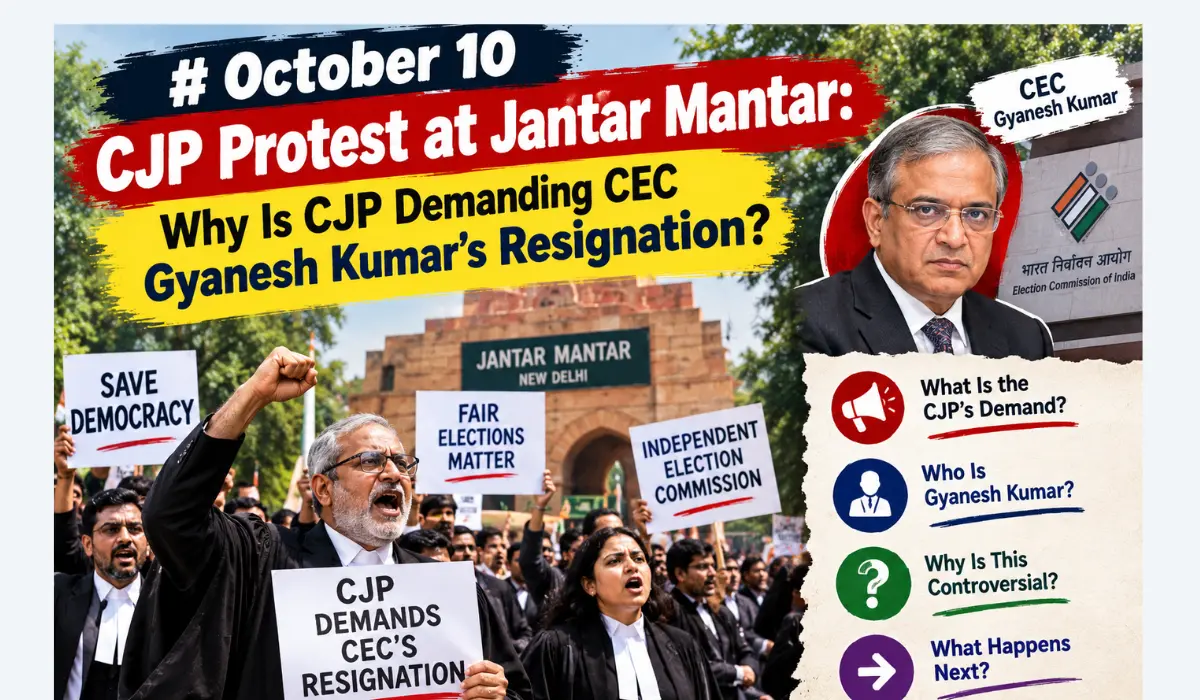
The Cockroach Janta Party (CJP), a youth-led protest movement founded by 30-year-old communications strategist Abhijeet Dipke, has called for a protest at Delhi’s Jantar Mantar on October 10, 2026 — which Dipke has dubbed “Jantar Mantar 2.0” — if Chief Election Commissioner (CEC) Gyanesh Kumar does not resign. The demand stems from allegations that the Election Commission mishandled the Special Intensive Revision (SIR) of electoral rolls. The protest follows an earlier CJP demonstration at Mumbai’s Shivaji Park on October 2, which drew thousands despite the police denying permission. Here’s the full story — who’s involved, what’s being demanded, and what’s likely to happen on October 10.
Who is the Cockroach Janta Party, and why that name?
Before getting to October 10, it helps to understand who’s organising it — because CJP isn’t a conventional political party.
The Cockroach Janta Party is a youth-based, satirical protest movement founded on 16 May 2026 by Abhijeet Dipke, a political communications strategist born in Chhatrapati Sambhajinagar (formerly Aurangabad), Maharashtra, in 1995. Dipke studied journalism in Pune, later earned a master’s in Public Relations at Boston University, and had previously worked with the Aam Aadmi Party’s social media team and as a communications adviser to the Delhi government’s education department.
The party’s unusual name is a direct response to a remark by Chief Justice of India Surya Kant, who compared unemployed young people holding fraudulent degrees to cockroaches. Dipke responded on X asking, “What if all cockroaches come together?” — a post that went viral and became the seed of the movement. CJP’s name is also a parody of the ruling Bharatiya Janata Party’s own initials, positioning itself as an “Indian People’s Party” for a generation that feels shut out of mainstream party politics.
CJP first grabbed national attention with a sustained, weeks-long protest at Jantar Mantar in June–July 2026 over repeated examination paper leaks (including the NEET exam), demanding the resignation of the then Union Education Minister, Dharmendra Pradhan. That protest lasted 36 days, saw a serious police crackdown on July 20 (including baton charges and tear gas when protesters attempted a march toward Parliament), and ultimately ended after Pradhan resigned in July — a result CJP and its supporters consider a major early victory for the movement.
Why is CJP protesting again — what is the SIR row?
The current protest campaign is rooted in the same controversy covered in earlier coverage of the broader October 2026 protests: the Special Intensive Revision (SIR) of electoral rolls, a large-scale, door-to-door re-verification of India’s voter lists carried out by the Election Commission of India under Article 324 of the Constitution and Section 21(3) of the Representation of the People Act, 1950.
The immediate trigger for CJP’s specific campaign was a media report — cited widely, including by Indian Express — that two of the three Election Commissioners, Sukhbir Singh Sandhu and Vivek Joshi, had recorded objections on at least 14 occasions over 10 months to decisions and orders related to the SIR, with some of those directions reportedly issued without their knowledge.
CJP has also made its own specific allegations about the scale of the issue. At press conferences, CJP leaders — including spokesperson Saurav Das — alleged that the BJP, after failing to secure an outright majority in the 2024 Lok Sabha elections, moved to remove voters’ names on a large scale in constituencies linked to opposition leaders, citing figures such as roughly 50,000 votes allegedly deducted in Mamata Banerjee’s constituency, around 1 lakh in M.K. Stalin’s, and roughly 40,000 in Arvind Kejriwal’s constituency. These are CJP’s claims, not independently verified facts, and they form part of the group’s public case for Kumar’s resignation rather than an established finding.
It’s worth being clear-eyed here: these are serious, specific allegations made by a protest movement, not conclusions reached by a court or an independent audit. The Supreme Court, in a May 27, 2026 verdict, had already upheld the SIR’s legal validity as an exercise — what remains contested is how individual decisions within that exercise were made, and whether the Commission’s internal functioning has been transparent.
What exactly is CJP demanding?
Based on statements from Dipke and other CJP leaders at multiple press conferences and protest sites, the demands include:
- Resignation of CEC Gyanesh Kumar, with some CJP leaders also demanding that he face criminal proceedings.
- A freeze on further changes to the January 2025 electoral roll, which CJP argues should not be “tampered with further” while the controversy is unresolved.
- A halt to the ongoing SIR process, pending what the group considers a fair and transparent review.
- Greater transparency in how Election Commissioners are appointed, reflecting the Opposition’s broader criticism of the 2023 law governing CEC and Commissioner appointments and removals.
- An independent, comprehensive probe into the alleged irregularities in the voter-roll revision process.
The timeline: from Mumbai to Delhi
| Date | Event |
|---|---|
| September 25, 2026 | Dipke publicly demands Kumar’s resignation within 48 hours and threatens a nationwide protest starting October 2 if he doesn’t step down |
| October 2, 2026 (Gandhi Jayanti) | CJP holds its protest at Mumbai’s Shivaji Park; thousands attend despite Mumbai Police denying permission; Shiv Sena (UBT) and MNS extend support |
| October 2, 2026 (same night) | Dipke announces “Jantar Mantar 2.0” — a follow-up protest at Delhi’s Jantar Mantar on October 10, calling it a fight to “save Indian democracy” |
| October 2, 2026 (Delhi, same day) | Separately, protests and detentions occur in Delhi itself, where police had denied permission for a demonstration at Jantar Mantar and imposed restrictions under Section 163 of the Bharatiya Nagarik Suraksha Sanhita (BNSS); reports put the number of people detained at roughly 700, with some estimates higher |
| October 6, 2026 | Delhi Police publicly deny rumours that Jantar Mantar has been “locked” or closed to protests, clarifying that it remains an authorised protest site subject to standard permission requirements |
| October 10, 2026 | CJP’s planned “Jantar Mantar 2.0” protest, contingent on whether CEC Gyanesh Kumar resigns beforehand |
Who’s backing the protest, and who’s pushing back?
Political backing: Congress leader and Leader of the Opposition Rahul Gandhi publicly backed the October 2 protesters, writing on X that “thousands of young people are on the streets against vote theft — peacefully, without violence, exercising their constitutional rights,” and criticising the detentions. He invoked Mahatma Gandhi, saying, “a lathi can stop a crowd, but not a question.” The Shiv Sena (UBT) and the Maharashtra Navnirman Sena (MNS) — both of which have a strong base in Mumbai’s Dadar area, where Shivaji Park is located — extended support to the Mumbai leg of the protest.
Government and EC response: The BJP has previously described CJP-linked protest movements as driven by a “false narrative,” with BJP MP Bansuri Swaraj saying during the earlier education-sector protest that the government remained open to dialogue and accused opposition figures of spreading misinformation. On the SIR issue specifically, the Election Commission has maintained that internal disagreements among commissioners are a routine part of institutional decision-making and that all its orders carry full legal sanction. The BJP has separately dismissed the broader “vote chori” narrative, citing the Supreme Court’s May 2026 verdict upholding the SIR’s legality as vindication of the process.
Local friction: Some residents near Shivaji Park reportedly voiced opposition to the protest being held in their neighbourhood, a reminder that reactions to these demonstrations aren’t split neatly along party lines.
Will the October 10 protest actually happen?
As of the most recent reporting, this remains conditional and genuinely uncertain, for a few specific reasons:
- Dipke has framed it as conditional: the protest proceeds only “if Gyanesh Kumar does not resign” by October 10.
- Permission is not guaranteed: Delhi Police have clarified that Jantar Mantar remains open for “authorised” protests, but permission must still be formally sought and granted — and CJP’s earlier protests have seen permission denied or heavily restricted at key moments, including the July 20 crackdown during the education-sector agitation.
- CJP activists have reported pressure: Dipke has separately claimed that party activists are facing pressure not to join the October 10 Delhi mobilisation, suggesting friction on the ground ahead of the planned date.
- A legal-aid and documentation effort is already in motion: CJP has set up a legal aid cell and an evidence-sharing platform called SAAKSHI, and Rajya Sabha MP Kapil Sibal has reportedly pledged ₹1 crore toward legal costs for protesters — signs that CJP is preparing for the possibility of detentions or FIRs around October 10, based on what happened during its earlier Jantar Mantar protest.
Given the pattern from CJP’s past protests — permission disputes, barricading, and at times forceful police responses — October 10 could unfold anywhere from a peaceful, permitted gathering to a tense standoff, depending on last-minute decisions by Delhi Police and whether Kumar’s position changes before then.
Why this keeps happening: the bigger pattern
It’s worth stepping back and noting the pattern here. This is CJP’s second major standoff with Delhi Police at Jantar Mantar within a few months — the first over alleged examination paper leaks, this one over alleged electoral roll irregularities. In both cases, the structure is similar: a specific, named resignation demand, an escalating series of public deadlines, a mass turnout despite permission disputes, and a government and ruling party that characterise the protest’s claims as exaggerated or false.
What makes the current protest different is the subject matter. Exam-related protests, however serious, concern a specific government department. A protest over the Election Commission’s conduct touches the institution responsible for conducting India’s elections — which is partly why Opposition parties, not just youth activists, have moved to back it so visibly.
Frequently asked questions
Who is Abhijeet Dipke?
Abhijeet Dipke is a 30-year-old Indian political communications strategist, originally from Chhatrapati Sambhajinagar, Maharashtra, and founder of the Cockroach Janta Party. He previously worked on digital campaigns with the Aam Aadmi Party and studied Public Relations at Boston University.Is CJP a registered political party?
CJP describes itself as a satirical, youth-led protest movement rather than a conventional, registered political party in the traditional electoral sense. It functions primarily as a protest and advocacy platform.What happened at the October 2 Mumbai protest?
Thousands gathered at Shivaji Park despite Mumbai Police denying permission for the demonstration. The protest demanded CEC Gyanesh Kumar’s resignation, a halt to the SIR process, and restoration of the January 2025 voter list.Why is the protest called “Jantar Mantar 2.0”?
Dipke used this term to describe the planned October 10 Delhi protest as a continuation of CJP’s earlier, prolonged Jantar Mantar agitation over examination paper leaks earlier in 2026, which ended after the then Education Minister resigned.What is the Election Commission’s official response to these allegations?
The EC has said that differences of opinion among commissioners during internal deliberations are a normal part of institutional functioning, and that all its decisions and orders carry full legal sanction under existing statutes.Has the Supreme Court ruled on any of this?
The Supreme Court upheld the legal validity of the SIR process itself in a May 27, 2026 verdict. It has not specifically ruled on the Opposition’s or CJP’s separate allegations about internal Commission disagreements or individual voter-roll deletions, which surfaced in media reports after that verdict.
Conclusion
The October 10 protest at Jantar Mantar is less a single event than the latest chapter in a fast-moving standoff between a youth-led protest movement, the Opposition, and India’s electoral authorities — layered on top of an already contested legal and political dispute over how the country’s voter rolls are being revised. Whether it happens as planned, gets restricted by Delhi Police, or is called off if the CEC resigns beforehand, it’s worth watching less for the spectacle and more for what it reveals: a growing willingness among young Indians to organise public pressure campaigns around institutional accountability, using tools and tactics that didn’t exist in Indian protest culture even a few years ago.
Related reading on Writer Sahibaa
Protests like this one often raise a deeper question: who actually holds institutions accountable when something goes wrong inside the system? For a look at how one real Indian administrator built a reputation for exactly that kind of institutional integrity, read:
- Tukaram Mundhe: The “Singham” IAS Officer’s Full Story — a useful contrast and context piece for readers thinking about what accountability inside India’s administrative and institutional machinery can look like in practice.