
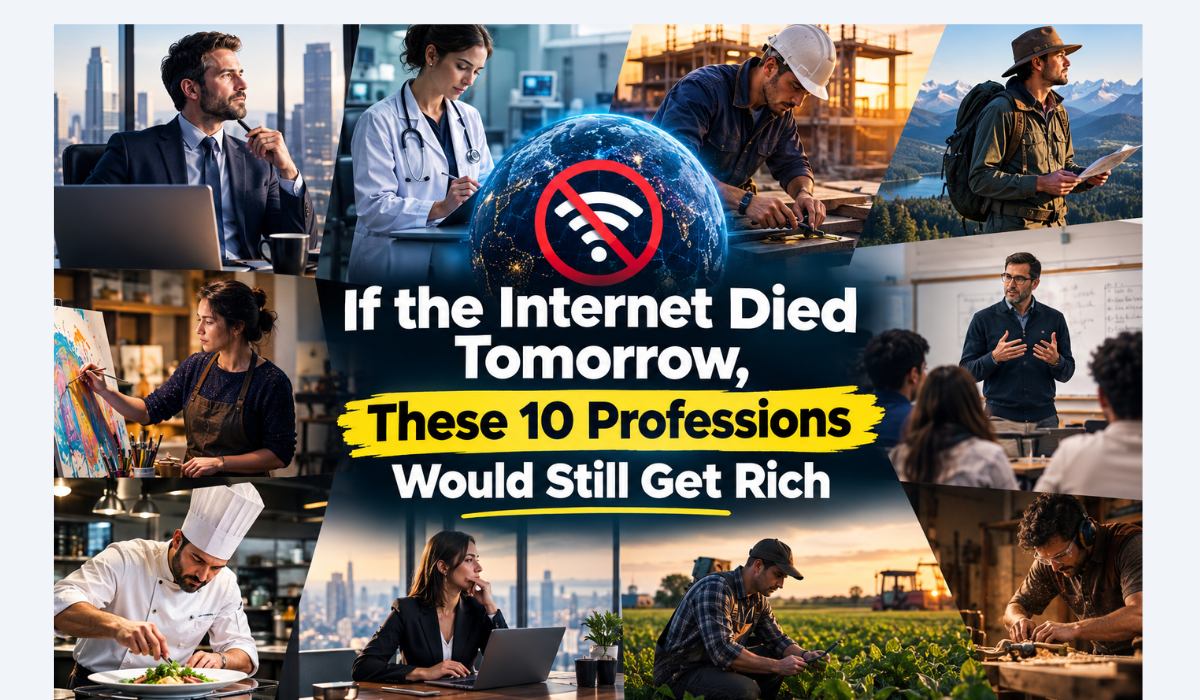
If the Internet Died Tomorrow, These 10 Professions Would Still Get Rich
Here’s a thought experiment worth sitting with for a minute: one morning, every router, server, and satellite link on Earth simply stops working. No cloud, no online banking, no e-commerce, no streaming, no search engines. Society doesn’t collapse — humans have survived without the internet for most of history — but the entire economic pecking order gets reshuffled almost overnight.
Some of today’s highest earners — software engineers, digital marketers, app founders — would suddenly find their skills far less valuable. Meanwhile, a handful of professions the internet age quietly pushed to the margins would come roaring back into demand, and with them, real pricing power and real wealth.
This is a thought experiment, not a prediction or financial advice — nobody’s suggesting you quit your job over it. But it’s a genuinely fun way to think about which skills are actually tied to the internet, and which ones just borrowed its infrastructure for a while.
Quick answer: Farmers and landowners would top the list almost immediately — food doesn’t need Wi-Fi, and controlling the supply of something everyone needs is the fastest route to real wealth in any scenario. Physicians, electricians, and skilled tradespeople follow close behind, since hands-on human skill was never actually dependent on the internet in the first place — it just got a digital scheduling system bolted on.
Key Takeaways
- The common thread across every profession on this list is physical necessity. Food, electricity, health care, and security don’t stop mattering just because the internet does — if anything, they matter more without digital shortcuts to manage them.
- Scarcity of skill matters more than scarcity of demand. Everyone would still need groceries, but not everyone can farm at scale, wire a building safely, or perform surgery — that gap is where the money would concentrate.
- Cash and tangible assets would surge in importance. Without digital banking and online markets, physical stores of value — gold, commodities, hard currency — become the practical way wealth actually gets held and moved.
- Information wouldn’t disappear, it would just get slower and more valuable. Whoever controls the fastest remaining channel for real news and knowledge — radio, print, physical archives — would suddenly matter enormously again.
Why “No Internet” Doesn’t Mean “No Economy”
It’s worth remembering that most of human economic history happened without the internet, and functioning, wealth-generating economies existed the entire time. What actually changes overnight is which skills carry a premium. Right now, a huge share of economic value flows through digital efficiency — being able to reach more customers, process more transactions, or automate more tasks than the next person. Take that efficiency layer away, and value flows straight back to whoever controls something scarce and essential in the physical world.
That’s the lens for this whole list: not “who’s clever,” but “who controls, produces, or fixes something everyone still needs the day after the internet goes dark.”
Quick Comparison Table
| Rank | Profession | Why They’d Win | What They’d Control |
|---|---|---|---|
| 1 | Farmers & Agricultural Landowners | Food never stops being essential | The literal food supply |
| 2 | Physicians & Surgeons | In-person care can’t be replaced by an app | Health outcomes |
| 3 | Electricians & Power Grid Engineers | The grid still needs to run | Physical infrastructure |
| 4 | Gold, Silver & Commodities Dealers | Digital money gets shakier, tangible value doesn’t | Stores of wealth |
| 5 | Private Security & Locksmiths | Tracking and surveillance tech goes dark | Physical safety |
| 6 | Truckers & Logistics Operators | Goods still need to physically move | The supply chain |
| 7 | Print & Broadcast Journalists | Fastest remaining way to reach millions | Information flow |
| 8 | Skilled Mechanics & Repair Tradespeople | No more ordering parts online or watching a repair tutorial | Fixing what’s already built |
| 9 | Librarians & Archivists | Physical knowledge becomes the only knowledge | Access to stored information |
| 10 | Bank Tellers & Cash-Handling Specialists | Commerce reverts to physical transactions | The flow of physical money |
The 10 Professions That Would Still Get Rich (Ranked)
1. Farmers & Agricultural Landowners
If there’s one truly universal human need that has nothing to do with Wi-Fi, it’s food. Without the internet, global supply chains slow dramatically, online grocery delivery disappears, and food distribution suddenly depends far more heavily on local and regional production. Whoever owns productive farmland and knows how to run it at scale would hold genuinely enormous leverage — food scarcity has been the fastest route to real economic power throughout most of history, long before anyone had a smartphone.
Why they’d win: Nothing replaces food, and large-scale farming knowledge isn’t something you can pick up overnight. What changes for them: Local food production and distribution networks would matter more than global ones, and land itself would become a more obviously valuable asset.
2. Physicians & Surgeons
Telemedicine, online symptom checkers, and digital health records all disappear the moment the internet does — but the actual skill of diagnosing and treating illness never depended on any of that. In-person medical expertise, especially surgical skill, is about as internet-independent as a profession gets, and it remains one of the most universally needed services on Earth.
Why they’d win: Health doesn’t wait for connectivity, and the years of training behind real medical skill can’t be replicated by any offline substitute. What changes for them: Record-keeping and communication would revert to paper and radio, but the actual value of their expertise stays exactly where it always was — arguably higher, given how much strain a slower system would put on care.
3. Electricians & Power Grid Engineers
Losing the internet doesn’t mean losing electricity — power grids and the internet are separate systems, even though we rarely think of them that way anymore. But everything that keeps electricity flowing reliably — maintenance, repairs, grid management — still needs skilled human hands, and demand for that expertise would only grow as digital monitoring tools that currently assist grid maintenance go offline.
Why they’d win: Modern life runs on electricity even more fundamentally than it runs on the internet, and keeping the grid stable becomes harder without digital diagnostic tools, not easier. What changes for them: More manual monitoring and troubleshooting, and a much higher premium on experienced engineers who know these systems without leaning on software.
4. Gold, Silver & Commodities Dealers
Digital banking, stock trading apps, and online currency exchanges all depend on the internet to function. Without it, confidence in purely digital stores of wealth would shake hard, and history offers a pretty clear playbook for what happens next — people flee toward tangible assets they can physically hold and verify. Gold and silver dealers, along with commodities traders dealing in oil, grain, and other physical resources, would suddenly find themselves at the center of how wealth actually gets stored and moved.
Why they’d win: Trust shifts toward what you can hold in your hand when digital systems become unreliable. What changes for them: Physical trading floors and in-person verification of goods would replace today’s largely digital commodities markets.
5. Private Security & Locksmiths
A world without the internet also loses most of its digital surveillance, tracking, and remote-monitoring security systems — the smart cameras, cloud-based alarm systems, and app-controlled locks that currently protect a huge share of homes and businesses. That gap doesn’t just disappear; it gets filled by human security professionals and old-fashioned mechanical locksmithing, both of which would see a genuine surge in demand almost overnight.
Why they’d win: Physical security becomes the only security once digital monitoring goes dark. What changes for them: A shift back toward manned guard posts, physical patrols, and mechanical locks and safes over anything “smart.”
6. Truckers & Logistics Operators
Online shopping and automated supply-chain software both vanish, but goods still need to physically move from where they’re made to where they’re needed. Without GPS-optimized routing and real-time inventory systems, the entire logistics chain becomes more manual and more valuable to control — the people who actually know regional routes, warehousing, and distribution by hand and by memory become genuinely essential.
Why they’d win: Physical goods movement doesn’t stop just because the software managing it does — it just gets harder, and harder means more valuable expertise. What changes for them: A return to paper manifests, radio dispatch, and route knowledge built from experience rather than an app.
7. Print & Broadcast Journalists
Social media, online news, and digital publishing all go dark with the internet, but people’s need for information doesn’t. Radio, television broadcast, and printed newspapers were the dominant information channels for most of the 20th century for a reason — they don’t require the internet at all. Whoever controls the fastest remaining way to reach a large audience would hold real influence and real commercial value almost immediately.
Why they’d win: Information doesn’t stop mattering, and legacy broadcast infrastructure is one of the few remaining ways to reach millions of people at once without the internet. What changes for them: A genuine resurgence of appointment-based news — the evening broadcast and the morning paper, both suddenly relevant again.
8. Skilled Mechanics & Repair Tradespeople
A huge amount of today’s repair culture depends on being able to order a replacement part online or watch a five-minute tutorial video. Take that away, and repair work reverts to what it always was before the internet: a genuine, hands-on skill that most people simply don’t have. Mechanics, appliance repair specialists, and general fix-it tradespeople would find themselves in a position where their knowledge, not a search engine, is the only path to getting something working again.
Why they’d win: DIY culture has quietly depended on the internet more than most people realize, and that dependency disappears overnight. What changes for them: A much higher premium on tradespeople who can diagnose and fix things from memory and experience, without a manual pulled up on a phone.
9. Librarians & Archivists
Search engines and online databases currently do most of the heavy lifting when it comes to finding information — a role libraries and archives filled for centuries before that. Without the internet, physical collections of books, records, and archives become the primary — sometimes only — route to organized knowledge, and the people who know how to navigate and manage those collections become genuinely indispensable.
Why they’d win: Knowledge doesn’t disappear, but finding it becomes dramatically harder without someone who knows exactly where to look. What changes for them: Libraries shift from a quiet public service to something closer to critical infrastructure for research, business, and education alike.
10. Bank Tellers & Cash-Handling Specialists
Online banking, digital wallets, and card payment networks all rely on internet connectivity to function in real time. Without it, commerce would lean far more heavily on physical cash and in-person banking — meaning the people who actually handle, verify, and move physical money would suddenly matter a great deal more than they do in a mostly cashless economy.
Why they’d win: Money still needs to move, and without digital rails, physical cash-handling becomes the backbone of everyday commerce again. What changes for them: Bank branches and physical currency exchange would see far more foot traffic and far more weight placed on manual, in-person transaction handling.
What This Thought Experiment Actually Teaches Us
The real takeaway isn’t “become a farmer” or “learn to fix appliances” — it’s that a lot of today’s most valuable-seeming skills are actually valuable because of the digital infrastructure wrapped around them, not because of the underlying skill itself. The professions on this list share one thing in common: they solve a problem that exists with or without the internet. That’s a genuinely useful lens for thinking about which skills hold up over time, internet apocalypse or not.
Frequently Asked Questions
Is this a real prediction about what would happen if the internet stopped working?
No — this is a thought experiment meant to explore which professions are most tied to physical necessity versus digital convenience. It’s not a forecast, and it’s not financial or career advice.Which profession would benefit the most if the internet disappeared?
Farming and agricultural land ownership would likely see the biggest shift in relative power, since food production is one of the few truly universal human needs that has never depended on internet connectivity.Would doctors and electricians really become more valuable without the internet?
Their underlying skills wouldn’t change at all — what would change is the loss of digital tools (telemedicine, remote grid diagnostics) that currently support them, meaning their hands-on expertise would carry even more weight than it already does.Why would cash and gold become more important without the internet?
Most digital banking, stock trading, and currency exchange depend on internet connectivity to function. Without it, trust shifts toward tangible assets people can hold and verify directly — a pattern seen historically whenever confidence in digital or paper systems weakens.Does this mean digital skills like coding or digital marketing would become worthless?
Not necessarily worthless, since local networks and offline computing would still exist, but their scale and reach would shrink dramatically without the internet connecting them to global audiences and markets — which is the core premise of this thought experiment.
Enjoyed this piece on mindful living? Explore more lifestyle, wellness, and personal growth reads on Writer Sahibaa.