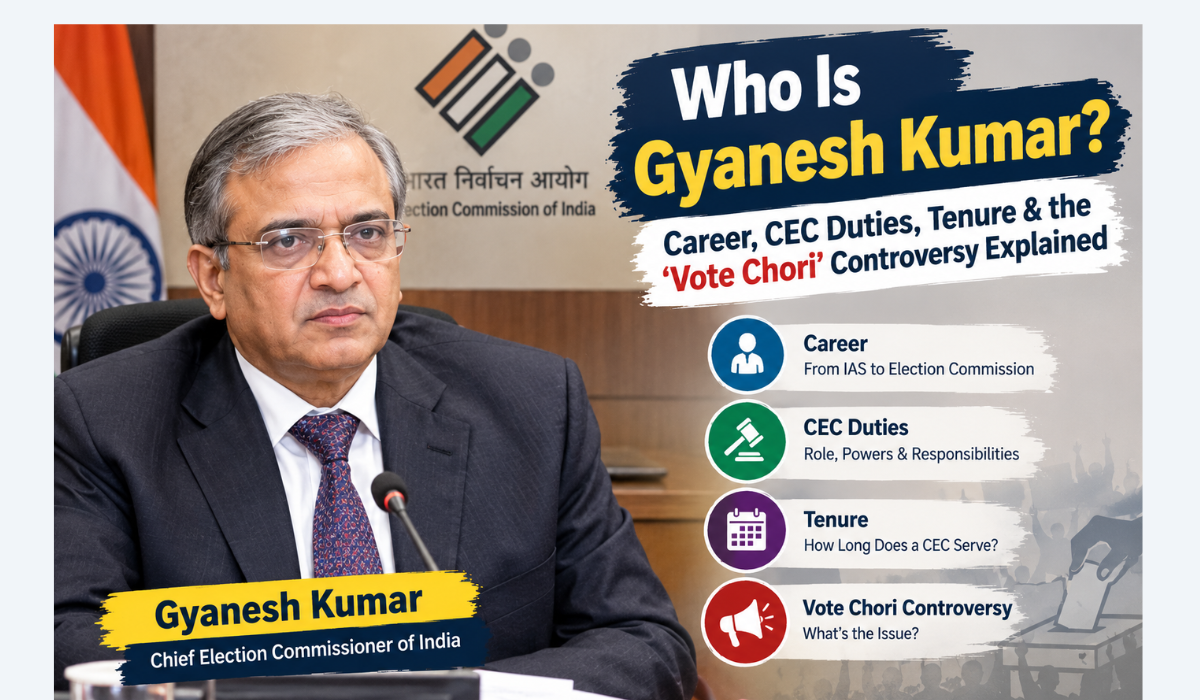
Who Is Gyanesh Kumar? Career, CEC Duties, Tenure & the ‘Vote Chori’ Controversy Explained
Gyanesh Kumar is a retired IAS officer of the 1988 Kerala cadre who became India’s 26th Chief Election Commissioner (CEC) on 19 February 2025 — the first CEC appointed under India’s new 2023 appointment law. Before joining the Election Commission, he held senior roles in the Union Home Ministry, where he played a key part in the 2019 abrogation of Article 370 in Jammu and Kashmir and in setting up the Ram Janmabhoomi Teerth Kshetra Trust. Since mid-2025, he has been at the centre of a major political storm, after Opposition leader Rahul Gandhi accused the Election Commission of “vote chori” (vote theft) linked to the Special Intensive Revision (SIR) of electoral rolls — allegations Kumar has publicly and firmly rejected. Here’s his full career, his role as CEC, and the controversy explained clearly.
Quick facts
| Full name | Gyanesh Kumar |
| Born | 27 January 1964, Agra, Uttar Pradesh |
| Service background | 1988-batch IAS officer, Kerala cadre |
| Education | B.Tech in Civil Engineering, IIT Kanpur; Business Finance, ICFAI; Environmental Economics, Harvard Kennedy School |
| Became Election Commissioner | 15 March 2024 |
| Became Chief Election Commissioner | 19 February 2025 (26th CEC) |
| Tenure ends | 26 January 2029 (he turns 65) |
| Preceded by | Rajiv Kumar |
| Appointed by | President Droupadi Murmu |
Early life and education
Gyanesh Kumar was born on 27 January 1964 in Agra, Uttar Pradesh. He studied civil engineering at IIT Kanpur, earning a B.Tech degree, and later added qualifications in business finance from ICFAI and environmental economics from the Harvard Kennedy School’s HIID programme in the United States. He cleared the civil services examination on his first attempt and joined the Indian Administrative Service in 1988, allotted to the Kerala cadre.
Career before the Election Commission
Kumar’s nearly four-decade administrative career spanned both state and central government, in some of India’s most consequential policy episodes.
In Kerala, he worked across departments including Finance, Public Works, and fast-track infrastructure projects, and served as Kerala’s Resident Commissioner at Kerala House in Delhi from 2012 to 2016.
At the Centre, his roles included:
- Joint Secretary, Ministry of Defence
- Joint Secretary (2016–2018) and later Additional Secretary (2018–2021), Ministry of Home Affairs
- Secretary, Ministry of Parliamentary Affairs
- Secretary, Ministry of Cooperation (until his retirement in January 2024)
His most politically significant work came during his Home Ministry years. As Additional Secretary handling Jammu & Kashmir and Ladakh affairs, Kumar played a central role in implementing the August 2019 abrogation of Article 370, which stripped Jammu and Kashmir of its special constitutional status, and in drafting the Jammu and Kashmir Reorganisation Bill that split the state into two Union Territories. Around the same period, he was also put in charge of the Home Ministry’s desk handling the Ayodhya case, including the 90-day process of setting up the Ram Janmabhoomi Teerth Kshetra Trust after the Supreme Court’s November 2019 verdict — he is reported to have closely monitored the Supreme Court hearings on the matter.
This background matters for understanding the current controversy: Kumar arrived at the Election Commission with a reputation as a trusted, senior bureaucrat who had executed some of the ruling government’s most significant and politically sensitive decisions — which is precisely why critics have questioned his independence, while supporters point to it as evidence of proven administrative capability.
Joining the Election Commission
Kumar retired from the IAS on 31 January 2024. Just weeks later, on 15 March 2024, President Droupadi Murmu appointed him as an Election Commissioner of India, alongside Sukhbir Singh Sandhu — filling vacancies ahead of the 2024 Lok Sabha general election. The Lok Sabha election schedule was announced the very next day, and Kumar, as Election Commissioner, was involved in conducting what remains the largest election exercise in the world, along with subsequent assembly elections in Jammu & Kashmir (its first since becoming a Union Territory), Haryana, Jharkhand, Maharashtra and Delhi.
Becoming Chief Election Commissioner
On 19 February 2025, Kumar succeeded Rajiv Kumar as India’s 26th Chief Election Commissioner. This appointment was historically significant for one specific reason: Kumar was the first CEC appointed under the Chief Election Commissioner and Other Election Commissioners (Appointment, Conditions of Service and Term of Office) Act, 2023.
This law changed how India selects its CEC and Election Commissioners. Previously, a Supreme Court interim order had required a selection committee including the Prime Minister, the Leader of the Opposition, and the Chief Justice of India. The 2023 Act replaced the Chief Justice of India on this panel with a Union Cabinet Minister nominated by the Prime Minister — meaning the selection committee now consists of the Prime Minister, the Leader of the Opposition, and a Cabinet Minister, giving the government a built-in majority on the panel.
This change was contested from the start. When Kumar’s appointment was finalised, Rahul Gandhi — then a member of the selection committee as Leader of the Opposition — submitted a formal dissent note, arguing on X that “the most fundamental aspect of an independent Election Commission free from executive interference is the process of choosing the Election Commissioner and Chief Election Commissioner,” and that removing the Chief Justice from the committee had “exacerbated concerns over the integrity of our electoral process.” The government proceeded with the appointment regardless, as the law permits a majority decision on the panel.
What does the Chief Election Commissioner actually do?
The CEC heads the Election Commission of India (ECI), a constitutional body established under Article 324 of the Constitution to superintend, direct and control elections to Parliament, state legislatures, and the offices of President and Vice-President. Core responsibilities include:
- Conducting free and fair elections, including announcing election schedules, enforcing the Model Code of Conduct, and overseeing the deployment of security forces and election officials nationwide.
- Maintaining and revising electoral rolls, including ordering special or intensive revisions when the Commission determines the existing rolls need updating.
- Registering and regulating political parties, and allotting electoral symbols.
- Overseeing the use of Electronic Voting Machines (EVMs) and VVPATs, and addressing disputes related to their use.
- Adjudicating certain election-related disputes and advising the President or Governor on questions of disqualification of sitting members.
Under Kumar’s leadership so far, the Commission has conducted and is currently preparing for Assembly elections across numerous states, is scheduled to oversee the 2027 Presidential and Vice-Presidential elections, and is preparing the ground — through the ongoing SIR exercise — for the 2029 Lok Sabha general election.
The ‘vote chori’ controversy: how it started
The controversy that now defines Kumar’s tenure traces back to a 31 July 2025 press conference by Rahul Gandhi, where, using data from the 2024 Lok Sabha election, he alleged that more than 1 lakh votes were “stolen” in the Mahadevapura assembly segment in Karnataka through what he described as five types of manipulation — duplicate voters, fake and invalid addresses, single-address voters, and more. This was the origin of Gandhi’s now-widely-used phrase, “vote chori” (vote theft).
Gandhi escalated this on 7 August 2025, broadening the allegations, and launched the Voter Adhikar Yatra in Sasaram, Bihar, specifically targeting the ongoing Special Intensive Revision (SIR) of Bihar’s electoral rolls, alleging double voting and systemic malpractice benefiting the ruling party.
The CEC’s response: an unusual, combative press conference
On 17 August 2025, Kumar held his first press conference since becoming CEC six months earlier — an 85-minute, data-heavy rebuttal, flanked by Election Commissioners Sukhbir Singh Sandhu and Vivek Joshi. Kumar:
- Rejected the “vote chori” allegations as baseless, saying: “Using words like ‘vote chori’ to mislead voters is an insult to the Indian Constitution.”
- Demanded that Gandhi submit a signed affidavit under oath supporting his specific claims within seven days, or else publicly apologise to the nation — saying “there is no third option.”
- Defended the SIR process itself, arguing it was necessary to “purify” Bihar’s electoral rolls and that doing so was consistent with the Commission’s duty under Article 326 of the Constitution (which guarantees adult suffrage).
- Asserted the Commission’s neutrality, saying it does not “differentiate between political parties,” and that “neither the EC nor the voters are scared” of the allegations.
- Noted that Chief Electoral Officers in the relevant states had already asked Gandhi to file a sworn affidavit, which he had declined to do at that point.
Gandhi did not submit the affidavit within the seven-day window, which the Commission and the BJP subsequently characterised as confirmation that the allegations lacked evidentiary backing. Gandhi, for his part, maintained that the burden of proof should not fall entirely on him, arguing that key underlying electoral data belonged to the Commission itself and that his team had been given unwieldy, non-machine-readable voter-list printouts that took months to analyse.
Escalation: Opposition explores impeachment, and new objections surface
The dispute did not end there. The INDIA bloc began exploring the possibility of an impeachment motion against CEC Kumar following his refusal to engage further with Gandhi’s allegations — reflecting how seriously the Opposition was treating the standoff.
Then, in September 2025, the controversy deepened further when media reports — most notably by the Indian Express — revealed that the two other Election Commissioners, Sukhbir Singh Sandhu and Vivek Joshi, had recorded formal objections at least 14 times over 10 months to SIR-related decisions, with some directions reportedly issued without their knowledge or recommendation. This fuelled fresh allegations from the Opposition and from civil-society groups like the Cockroach Janta Party (CJP) that the Commission’s internal decision-making process was not as unified or transparent as its public statements suggested.
The Election Commission’s position on this has remained consistent: that differences of opinion among commissioners during internal deliberations are a normal part of institutional functioning, and that its final orders carry full legal sanction under existing law.
Where things stand now: protests demanding Kumar’s resignation
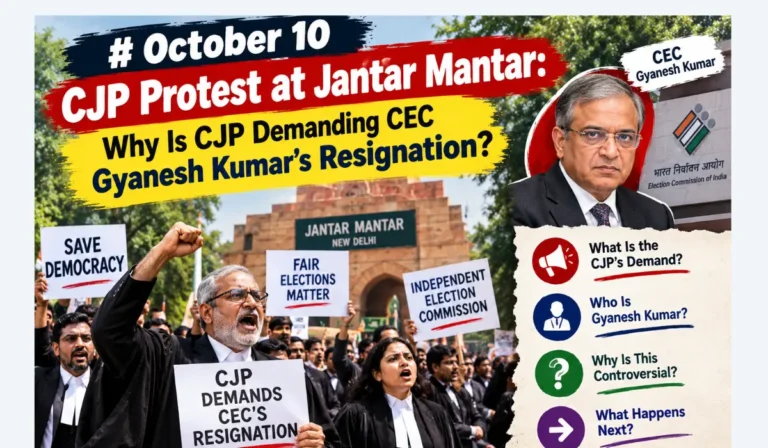
By late September and early October 2026, the controversy moved from press conferences into the streets. The Cockroach Janta Party, a youth-led protest movement, launched a sustained campaign specifically demanding Kumar’s resignation:
- October 2, 2026: CJP held a major protest at Mumbai’s Shivaji Park, drawing thousands despite the police denying permission, with CJP founder Abhijeet Dipke calling Kumar the “biggest anti-national” and demanding his resignation, a freeze on the SIR process, and restoration of the January 2025 electoral rolls.
- October 10, 2026: CJP announced a follow-up protest at Delhi’s Jantar Mantar — which Dipke called “Jantar Mantar 2.0” — contingent on whether Kumar resigns beforehand.
Rahul Gandhi publicly backed these protests, writing that “a lathi can stop a crowd, but not a question,” while the BJP has continued to characterise the broader “vote chori” narrative as a politically motivated, false campaign — pointing to the Supreme Court’s 27 May 2026 verdict, which upheld the legal validity of the SIR process itself as a constitutionally permissible exercise of the Election Commission’s powers under Article 324.
It’s important to separate two distinct questions here, since they’re often blurred in public debate:
- Is the SIR legally valid? Yes — the Supreme Court has settled this question.
- Was the SIR implemented fairly and transparently in every instance, and is CEC Kumar personally responsible for any shortcomings? This remains a live, contested political dispute, not something any court has definitively ruled on.
Is Gyanesh Kumar likely to resign?
As of now, there is no indication that Kumar intends to resign. He has publicly and repeatedly rejected the allegations against him as baseless, and the Election Commission has defended both his conduct and its institutional processes. A sitting CEC in India can only be removed through a process similar to the impeachment of a Supreme Court judge — requiring a special parliamentary majority — which is procedurally difficult and, given the government’s parliamentary strength, currently unlikely to succeed even if formally initiated. Any resignation, if it were to happen, would most likely come from sustained political pressure rather than any existing legal or procedural requirement.
Frequently asked questions
Who is Gyanesh Kumar? Gyanesh Kumar is a retired 1988-batch IAS officer from Kerala cadre who became India’s 26th Chief Election Commissioner on 19 February 2025, after earlier serving in senior Union Home Ministry and Cooperation Ministry roles.
What is Gyanesh Kumar’s tenure as CEC? He became CEC on 19 February 2025 and his term runs until 26 January 2029, when he turns 65 — the mandatory retirement age for the position.
Why is Gyanesh Kumar being asked to resign? Protesters, including the Cockroach Janta Party, and Opposition leaders including Rahul Gandhi, allege mismanagement and lack of transparency in the Special Intensive Revision (SIR) of electoral rolls, and point to internal objections reportedly raised by two other Election Commissioners. Kumar and the Election Commission have firmly rejected these allegations as baseless.
What is ‘vote chori’? It’s a Hindi phrase meaning “vote theft,” popularised by Rahul Gandhi from mid-2025 onward to describe alleged irregularities in India’s electoral rolls, which he says disproportionately benefit the ruling party. The Election Commission and the BJP reject this characterisation.
Did Rahul Gandhi submit the affidavit the CEC demanded? Public reporting indicates Gandhi did not submit a signed affidavit within the seven-day window the CEC set in August 2025, which the Commission and the BJP have since cited as evidence the allegations lacked formal backing. Gandhi has argued the relevant data belongs to the Commission itself.
Has the Supreme Court ruled on the SIR controversy? The Supreme Court ruled on 27 May 2026 that the SIR process itself is legally valid and within the Election Commission’s constitutional powers. It has not specifically adjudicated the separate political allegations about internal Commission disagreements or how individual voter-roll decisions were made.
Can the Chief Election Commissioner be removed from office? Yes, but only through a process similar to the impeachment of a Supreme Court judge, requiring a special majority in Parliament — a high procedural bar that is not currently expected to succeed given the ruling party’s parliamentary numbers.
Conclusion
Gyanesh Kumar’s career traces a straight line from some of the Indian government’s most consequential administrative decisions of the past decade — Article 370’s abrogation, the Ram Temple trust — to the country’s most powerful election oversight role. That same background is now exactly what’s being contested: is he a seasoned administrator doing a difficult, high-pressure job fairly, or a product of an appointment process tilted toward the government he long served? The Supreme Court has settled the narrow legal question of whether the SIR itself is valid. Whether Kumar’s own conduct and the Commission’s internal transparency measure up to the trust the role demands is a question still playing out — in press conferences, in Parliament, and now, increasingly, on the streets.
Related reading on Writer Sahibaa
For the latest on how this controversy has moved from press conferences to the streets, read:
- October 10 CJP Protest at Jantar Mantar: Why Is CJP Demanding CEC Gyanesh Kumar’s Resignation? — the full story of the protest movement built specifically around the demand covered in this article.