Nepal-Tibet Floods: What Happened and Why Is the Himalayan Region Under Threat?
On 26 August 2026, a massive flash flood tore through the Nepal-Tibet border region, killing dozens — with Nepali police reporting a toll climbing toward 95 — and leaving close to 400 people missing, including over 100 Indian tourists. The flood was likely triggered by an ice-rock avalanche that blocked a Himalayan river before releasing a sudden surge downstream, possibly set off by a small earthquake minutes earlier. But this wasn’t a freak, one-off event — scientists say it’s part of a growing pattern. The Himalayas are now experiencing glacial lake outburst floods (GLOFs) nearly five times more often than before 1950, driven directly by climate change melting the region’s glaciers faster than ever before.
If you’re seeing this story alongside a video from the disaster zone, we’ll get to that below. First, here’s what actually happened, and why this region keeps ending up in headlines like this one.
What Happened on 26 August 2026
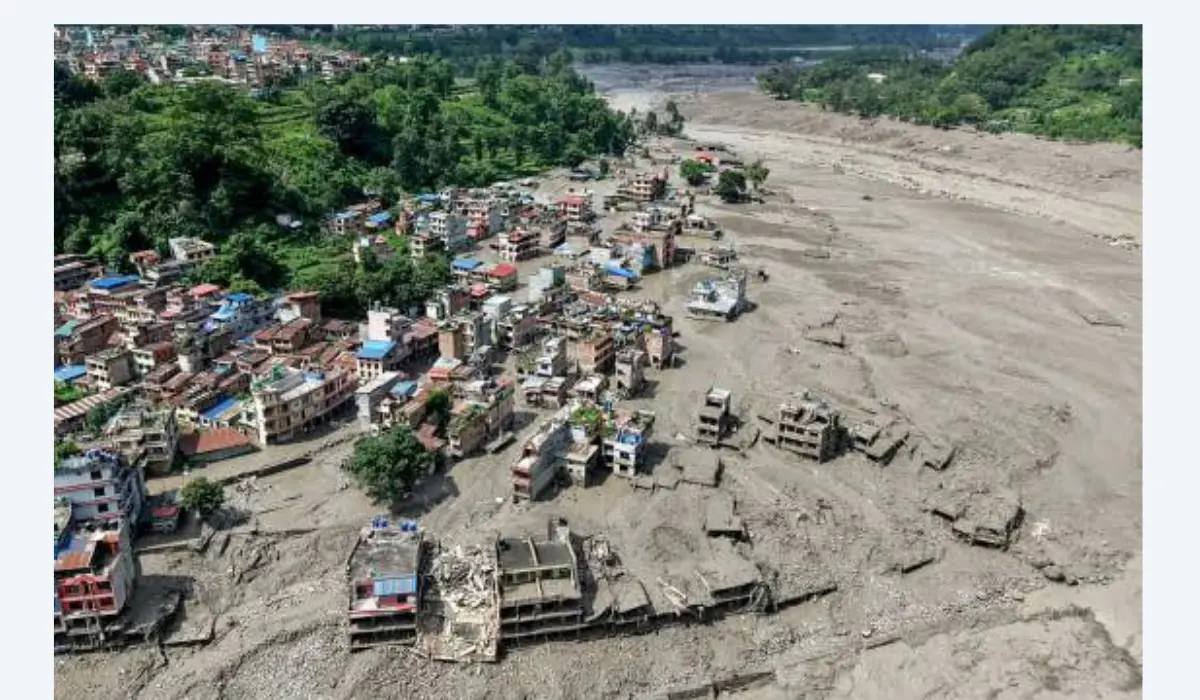
Early Wednesday morning, a wall of mud, rock, and water surged down the Lhende Khola river in Nepal’s Rasuwa district — a mountainous area about 120 km northeast of Kathmandu — before crashing into the larger Bhote Koshi river. Riverside settlements, roads, bridges, and hydropower stations were destroyed as the flood moved downstream. Security camera footage from the Chinese side reportedly showed people running moments before the wave of debris hit.
Across the border, the same event triggered a mudslide at Gyirong, a major trade crossing between Nepal and Tibet in China’s Shigatse region, cutting off roads, power, and communications there as well.
A health worker in Rasuwa described the scene bluntly, saying the riverside settlements had been completely swept away. A Kathmandu-based climate activist told reporters the flood had wiped out entire villages, along with schools, bridges, and highways.
The Numbers — Still Changing by the Hour
This is genuinely a developing story, and the figures below reflect reporting as of 26 August 2026. Expect these to shift as rescue teams reach areas that were completely cut off.
Nepali police confirmed at least 95 deaths, with 28 police personnel among the missing. Nepal’s Tourism Board reported 384 travelers unaccounted for — 291 foreign nationals and 93 Nepali citizens. Among the missing tourists: roughly 105 Indian nationals (including 37 non-resident Indians), along with visitors from the United States, the United Kingdom, Malaysia, South Africa, Australia, and the Netherlands. Around 60 workers from an under-construction hydropower project are also unaccounted for.
On the Chinese side, authorities in Tibet’s Gyirong county reported 3 confirmed deaths and 265 people missing, based on a preliminary assessment still being verified.
What Actually Caused It
Scientists haven’t confirmed an official cause yet, but the leading explanation points to a chain reaction. The German Research Centre for Geosciences (GFZ) recorded a magnitude 4.4 earthquake along the Nepal-China border at around 8:37 a.m. local time — roughly seven minutes before security footage shows the flood hitting.
Saswata Sanyal, a disaster risk reduction specialist at the International Centre for Integrated Mountain Development (ICIMOD) in Kathmandu, said the likely sequence was an ice-rock avalanche that blocked the river before it gave way, releasing a sudden surge downstream. He also flagged something worth paying attention to: this is the second time the Lhende Khola has flooded in the past 14 months — not the first.
That detail is the real bridge to the bigger question this article is here to answer.
Why Is the Himalayan Region Under Threat? The Science Behind the Pattern
This flood didn’t happen in isolation. It’s part of a documented, accelerating trend that climate scientists have been warning about for years: glacial lake outburst floods, or GLOFs.
What a GLOF Actually Is
As glaciers melt, they often leave behind lakes dammed by loose rock, ice, or moraine debris — natural dams that were never built to hold back that much water permanently. When something disturbs that dam — an avalanche, a landslide, an earthquake, or just sustained warming weakening the ice — the lake can burst suddenly, sending a catastrophic wall of water, mud, and debris downstream with almost no warning.
The Numbers Are Genuinely Alarming
According to research highlighted by the United Nations University, the Hindu Kush Himalaya region — spanning Afghanistan, Pakistan, India, China, Nepal, Bhutan, Bangladesh, and Myanmar — holds the largest concentration of glacial ice outside the polar regions, and it has become a global hotspot for this exact kind of disaster. Around 2 billion people living in and downstream of these mountains are exposed to GLOF risk.
The most striking figure: the average number of GLOF events per decade in the Himalayas is now nearly five times higher than it was before 1950. Researchers directly link this surge to climate change — specifically, the formation and expansion of glacial lakes as ice melts faster, combined with a rise in the events that can trigger a collapse, like avalanches, landslides, and sudden ice breaks. More than 9,000 lives have been lost across the region to GLOFs, with India, Pakistan, Nepal, and Bhutan among the hardest-hit countries.
A separate study published in Nature Climate Change found that the eastern Himalaya — the exact region where this week’s flood occurred — already carries a GLOF risk level at least twice that of neighboring areas, and that risk is projected to nearly triple in the coming decades as glacial lakes continue forming and expanding.
Why This Keeps Happening in the Same Places
Part of what makes this region so exposed is a combination of factors stacking on top of each other:
- Faster glacial melt. Rising temperatures are shrinking Himalayan glaciers more quickly than models predicted even a decade ago, creating new lakes and expanding existing ones.
- Unstable natural dams. Many of these lakes are held back by loose moraine or ice — not solid rock — making them inherently fragile.
- More trigger events. Avalanches, landslides, and small earthquakes are common in this tectonically active, steep terrain, and any one of them can be enough to break a weakened dam.
- Growing infrastructure in harm’s way. Hydropower projects, roads, and settlements have expanded into these high-altitude valleys over the past two decades, meaning more people and more expensive infrastructure now sit directly in a GLOF’s path than ever before.
- Limited early warning in remote areas. Many of the most at-risk lakes sit in extremely remote, hard-to-monitor terrain, which means communities often get little to no advance warning before a dam fails.
This is exactly why Wednesday’s flood on the Lhende Khola — its second in 14 months — isn’t being treated as a one-off tragedy by disaster scientists. It’s being read as a warning sign of a pattern that’s very likely to repeat, in this valley or a neighboring one, unless monitoring and early-warning systems catch up with how fast the underlying risk is changing.
The Cross-Border and Downstream Impact
The damage from this flood didn’t stay contained to one valley or one country:
- Power grid: Nepal’s energy ministry reported around 430 megawatts of electricity supply disrupted — more than 12% of the country’s total national hydropower capacity of roughly 3.2 gigawatts.
- Cross-border trade: The Gyirong crossing between Nepal and Tibet, an important trade route, has been cut off entirely.
- Downstream flood risk in India: The Bhote Koshi feeds into Nepal’s Trishuli river, which becomes the Gandak river as it crosses into India. Flood alerts have been issued in India’s Bihar and Uttar Pradesh states, and Bihar has already begun evacuating residents from six affected districts as a precaution.
India’s Response: Aid, Rescue Teams, and Solidarity
India moved quickly once the scale of the disaster became clear. External Affairs Minister Subrahmanyam Jaishankar confirmed that India is sending 10 metric tons of humanitarian aid and essential medicines to Nepal, saying India stands with Nepal and its people during the crisis. Indian Prime Minister Narendra Modi also posted that India stands in solidarity with its neighbors in Nepal and is ready to provide all possible humanitarian assistance.
On the ground, India’s response includes:
- Indian Air Force planes transporting relief material directly to Nepal
- National Disaster Response Force (NDRF) teams being deployed to assist with rescue and relief operations
- Five drones mobilized to help locate missing persons in hard-to-reach terrain
- Three sniper dogs dispatched specifically to search for people trapped in debris
This isn’t the first time India has stepped in for Nepal during a disaster — India was the first responder after Nepal’s devastating 2015 earthquake under Operation Maitri, and has sent relief materials following multiple flood and landslide events since. Beyond India, the International Federation of Red Cross and Red Crescent Societies has committed $1.2 million in emergency funding to the Nepal Red Cross, and the European Union has activated its Copernicus satellite service to help map the affected areas.
Key Facts at a Glance
| Detail | Reported Figure (26 Aug 2026) |
|---|---|
| Confirmed deaths, Nepal | At least 95, expected to rise |
| Confirmed deaths, Tibet | 3 (preliminary) |
| Missing, Nepal | 384 (291 foreign nationals, incl. ~105 Indians) |
| Missing, Tibet | 265 (preliminary) |
| Likely cause | Ice-rock avalanche blocking Lhende Khola, possibly triggered by M4.4 quake |
| Nepal’s power capacity affected | ~12% (430 MW) |
| GLOF frequency increase since 1950 | ~5x higher per decade |
| People exposed to GLOF risk (Hindu Kush Himalaya) | ~2 billion |
| India’s aid sent | 10 metric tons humanitarian aid + medicines, NDRF teams, IAF planes |
Frequently Asked Questions
What caused the Nepal-Tibet flood?
The likely cause was an ice-rock avalanche that blocked the Lhende Khola river before releasing a sudden surge of water downstream, possibly triggered by a magnitude 4.4 earthquake recorded minutes before the flood hit.What is a glacial lake outburst flood (GLOF)?
A GLOF happens when a lake formed by melting glacier ice — often dammed by loose rock or moraine — suddenly breaks through its natural dam, releasing a massive, fast-moving flood of water and debris downstream with little warning.Why are Himalayan floods becoming more frequent?
Climate change is accelerating glacial melt, which creates and expands unstable glacial lakes. Combined with more frequent avalanches, landslides, and earthquakes in the region, this has pushed the average number of GLOF events per decade to nearly five times what it was before 1950.Has India sent help to Nepal after this flood?
Yes. India has sent 10 metric tons of humanitarian aid and medicines via Indian Air Force planes, deployed National Disaster Response Force teams, and mobilized drones and search dogs to assist with rescue operations.Will this flood affect India directly?
Flood alerts have been issued in India’s Bihar and Uttar Pradesh states, since the river system affected eventually flows into India as the Gandak river. Bihar has begun evacuating residents from six districts as a precaution.
Key Takeaways
- A flash flood on the Nepal-Tibet border has killed dozens (toll approaching 95) and left hundreds missing, including over 100 Indian tourists.
- The likely trigger was an ice-rock avalanche blocking a river before releasing a sudden downstream surge, possibly set off by a small earthquake.
- This wasn’t an isolated incident — the same river has now flooded twice in 14 months, and Himalayan GLOF events overall are nearly five times more frequent than before 1950.
- Roughly 2 billion people across the Hindu Kush Himalaya region live with some level of exposure to this exact type of disaster.
- India has responded quickly with aid, rescue teams, and high-level statements of solidarity, continuing a long pattern of disaster response support to Nepal.
- Scientists expect this risk to keep rising — GLOF risk in the eastern Himalaya is projected to nearly triple in the coming decades without stronger monitoring and early-warning systems.
This week’s tragedy on the Nepal-Tibet border is a human disaster first — but it’s also a clear signal from a region that scientists have been warning about for years. As glaciers keep retreating and mountain communities keep expanding into these valleys, the real question isn’t whether another flood like this will happen again. Based on what the data already shows, it’s simply a matter of where, and how prepared the region will be when it does.