
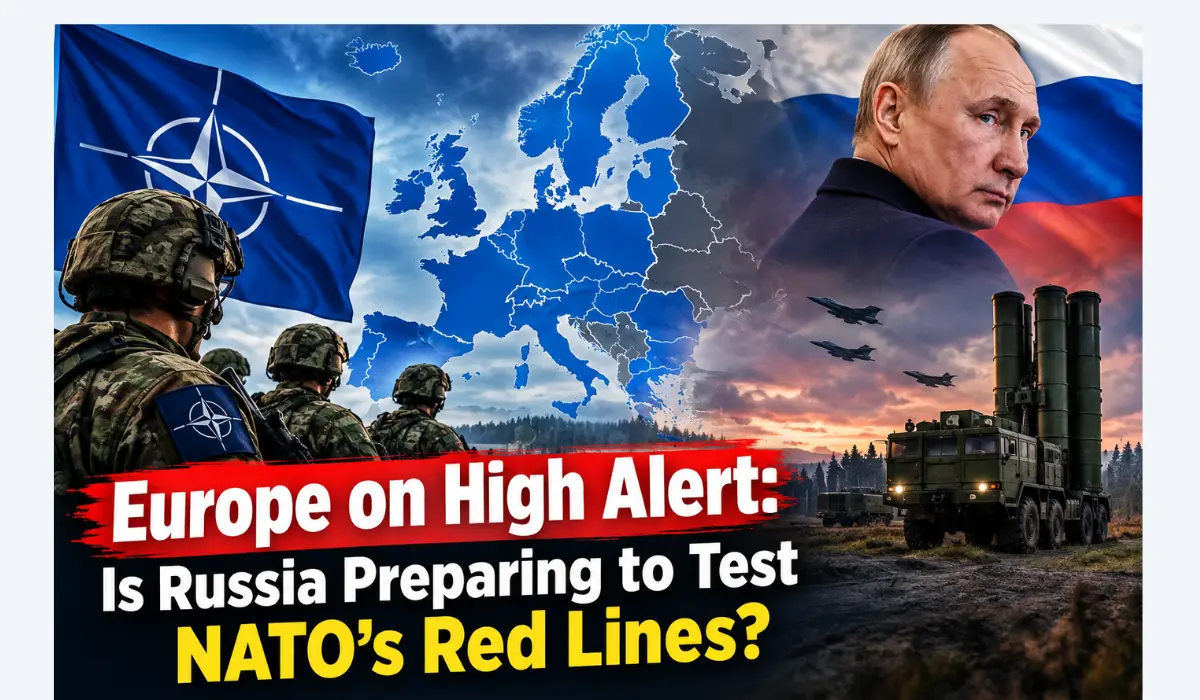
Europe on High Alert: Is Russia Preparing to Test NATO’s Red Lines?
Something has shifted in Europe over the past few weeks, and it isn’t subtle anymore. Drones are showing up where they shouldn’t. Fighter jets are being scrambled over NATO territory. A CIA director quietly flew to Moscow and back in a single day. And in the background, two of the loudest storylines of 2026 — a US security deal in Greenland, and a major American troop drawdown from Europe — are reshaping exactly what “NATO’s red line” even means right now.
This isn’t alarmist speculation. It’s what’s actually happening, pulled from reporting by CNN, the Atlantic Council, the Associated Press, and other verified sources. Here’s the clearest picture available of where things stand.
Is Europe Actually Under Threat?
- Yes, tensions are real and escalating — but most analysts describe it as “grey-zone” pressure, not preparation for open war. Russia is testing NATO’s response threshold without crossing the line that would trigger a collective military reaction.
- In the past few weeks alone: a Russian drone struck near the Polish border, NATO jets shot down a drone over Lithuania, and a Russian warship fired flares at a Danish helicopter over the Baltic Sea.
- CIA Director John Ratcliffe made an unannounced trip to Moscow in August 2026, reportedly warning Russian officials against any attack on NATO members, particularly the Baltic states.
- The US and Denmark struck a Greenland security deal in September 2026 — but Greenland was not “taken.” It remains Danish territory; the US gained expanded military and security rights, not ownership.
- The US is actively reviewing a major troop drawdown from Europe — potentially 25,000 to 40,000 personnel — though Congress has pushed back with legislation limiting how far this can go.
- Most experts believe Putin does not want a direct war with NATO, but is trying to fracture alliance unity and pressure Europe into abandoning support for Ukraine.
The Pattern: What “Grey-Zone” Escalation Actually Looks Like
Analysts increasingly describe Russia’s approach as a strategy built on a specific contradiction: making war feel closer without actually starting one, and alarming European publics without forcing a real military response. Recent incidents fit that pattern closely.
According to reporting from Israel Hayom, in just the past week, a Russian drone struck a passenger train roughly two kilometers from the Polish border, NATO aircraft shot down a drone over Lithuania, and a Russian warship fired flares toward a Danish helicopter over the Baltic Sea — and that’s described as only a partial list. Polish Prime Minister Donald Tusk has warned of a genuine risk that drones or missiles could enter NATO’s eastern flank and cause damage, with Moscow then attempting to describe the incident as accidental.
The Atlantic Council frames this escalation not as a sign of Russian strength, but of mounting pressure at home: the Russian army has made only minimal territorial gains throughout 2026 despite heavy losses, while Ukraine’s strategic bombing campaign has brought real costs back to Russian soil. Seen that way, the pressure campaign against Europe looks less like confidence and more like an attempt to force a political win that the battlefield hasn’t delivered.
The Ratcliffe visit
One of the more striking data points in this story: on August 25, 2026, CIA Director John Ratcliffe made an unannounced visit to Moscow, staying only a few hours. According to multiple reports, he warned Russian officials against any attack on NATO territory, with specific emphasis on the Baltic states, and reaffirmed continued US commitment to Article 5 — NATO’s collective-defense clause. It was reportedly the first known visit to Moscow by a sitting CIA director since 2021, when then-CIA Director William Burns delivered a similar warning ahead of Russia’s invasion of Ukraine.
The Greenland Deal: What Actually Happened (Not “Taken for Free”)
This is one of the most misunderstood stories in the current news cycle, so it’s worth being precise about it.
On September 18–19, 2026, the United States and Denmark announced a security agreement covering Greenland. President Trump described it as giving the US “permanent control over security, and all other needs” on the island, and said the US would begin building a larger military presence there. But here’s the important distinction that a lot of headlines gloss over: Greenland was not annexed, purchased, or given away. It remains part of the Kingdom of Denmark. What changed is the scope of US military and security access.
Under the deal:
- The US gets expanded rights to build military infrastructure in Greenland.
- Non-NATO countries are barred from establishing any base there.
- Adversary nations — explicitly including Russia and China — are blocked from making sensitive investments or stationing personnel in Greenland without US authorization.
- Formal signing was expected the week of September 21, 2026, during the UN General Assembly session, and still requires parliamentary approval in both Copenhagen and Nuuk.
This followed months of tension that included Trump publicly refusing to rule out the use of military force to acquire Greenland, and large “Hands Off Greenland” protests across Denmark and Greenland earlier in 2026 — the largest demonstrations in Greenland’s history, according to reporting on the protests. Danish Prime Minister Mette Frederiksen has characterized the final deal as a defense of Greenlandic sovereignty rather than a loss of it, while US officials have framed it as a major strategic win, particularly given Russia’s decades-long military buildup in the Arctic and China’s growing interest in the region.
The US Troop Drawdown From Europe: How Big, and How Real?
This is the other major shift reshaping the security conversation — and like Greenland, the details matter more than the headlines.
In July 2026, the Pentagon launched a six-month review of the American military footprint in Europe, described as the most significant reassessment of US posture on the continent in decades. The starting point: roughly 80,000 US military and civilian personnel currently in Europe, down already from about 100,000 shortly after Russia’s 2022 invasion of Ukraine.
Reports on the scale of a potential drawdown vary, but center on:
| Detail | Figure |
|---|---|
| Current US personnel in Europe | ~80,000 (down from ~100,000 in 2022) |
| Proposed reduction under discussion | 25,000–40,000 troops |
| Germany’s current US troop presence | ~36,000 (largest hub in Europe) |
| Italy’s current US troop presence | ~12,000 |
| Congressional floor on reductions (2026 NDAA) | Cannot fall below 76,000 without formal certification to Congress |
Earlier in 2026, the US had already reduced NATO-committed fighter aircraft in Europe from 150 to 100 and pulled every aerial refueling tanker off the continent — described by some defense analysts as the first visible sign of this broader pattern. The Trump administration’s position, reflected in its January 2026 National Defense Strategy, is that the US will provide “critical but more limited” support for European defense going forward, expecting European allies to shoulder more of their own conventional deterrence while the US retains its nuclear guarantee and focuses more attention on the Indo-Pacific.
Congress, however, has pushed back. The finalized 2026 National Defense Authorization Act blocks reductions below 76,000 troops in Europe without the Pentagon formally certifying to Congress that the move won’t damage US or NATO security interests, and it codifies the US position of NATO’s top military commander (SACEUR) into law. European officials have publicly urged Washington to coordinate any drawdown carefully, warning that an uncoordinated reduction could weaken deterrence along NATO’s eastern flank at the exact moment tensions are rising.
So — Is Russia Actually Preparing to Test NATO?
Putting these threads together, here’s the most balanced read of where things stand, based on current expert analysis:
- Direct war is considered unlikely. Most Western analysts, including those at the Atlantic Council, assess that Putin does not want to provoke a scenario that would trigger NATO’s Article 5 and a unified military response.
- A limited “test” scenario is taken seriously. One widely discussed scenario involves a small, deniable incursion along NATO’s eastern flank — potentially framed as protecting ethnic Russians — designed to see whether the alliance responds with unity or hesitation.
- The real risk isn’t a single dramatic event — it’s an accident. With drone incidents, jet incursions, and naval confrontations now a near-weekly occurrence, the growing concern among security officials is a miscalculation: an incident that escalates faster than either side intends.
- Europe’s response is becoming more assertive. Poland’s warnings, the EU’s Eastern Flank Watch defense initiative launching in 2026, and increased NATO air policing missions all reflect an alliance trying to close gaps rather than wait them out.
What This Means Going Forward
Europe’s security picture right now is genuinely more complicated than “Russia vs. NATO.” It’s a three-way pull: Russia probing for weaknesses without triggering a war it likely can’t win outright; the US recalibrating its footprint and priorities in ways that create real uncertainty for allies; and European governments trying to close the resulting gap through initiatives like the EU’s Eastern Flank Watch program. Whether that gap closes fast enough is arguably the more urgent question than whether Russia will attack outright.
Frequently Asked Questions
Did Russia attack a NATO country?
Not directly. Recent incidents — drone intrusions, a drone shot down over Lithuania, flares fired near a Danish helicopter — are described by NATO and European officials as part of a deliberate “grey-zone” pressure campaign, designed to stay just below the threshold that would trigger a formal Article 5 military response.Did the US take over Greenland?
No. A September 2026 US-Denmark security agreement expanded American military access and security control in Greenland, but the island remains part of the Kingdom of Denmark. The deal still requires parliamentary approval in both Denmark and Greenland.Is the US really withdrawing all its troops from Europe?
No — a significant reduction (potentially 25,000–40,000 troops) is under active review, but it is not a full withdrawal. US law currently requires the Pentagon to keep at least 76,000 troops in Europe unless it formally certifies to Congress that a deeper cut won’t harm NATO security.Why did the CIA director visit Moscow?
CIA Director John Ratcliffe made an unannounced visit in August 2026, reportedly to warn Russian officials directly against attacking any NATO member state, especially the Baltic states, and to reaffirm continued US commitment to NATO’s collective-defense clause.What is NATO’s Article 5, and why does it matter here?
Article 5 is NATO’s collective-defense commitment — an attack on one member is treated as an attack on all. Much of the current tension centers on whether Russia might attempt a limited, deniable provocation specifically designed to avoid triggering it.
Key Takeaways
- Russia’s recent actions across Europe fit a documented “grey-zone” pattern — provoke and alarm, without crossing the line that forces a unified NATO response.
- The US-Denmark Greenland deal expands American security control but does not change Greenland’s sovereignty — it remains Danish territory.
- A major US troop drawdown from Europe is under serious discussion, but Congress has placed a legal floor on how far it can go.
- Most analysts see a direct Russia-NATO war as unlikely, with the bigger risk being an accidental escalation from repeated incidents.
- Europe is responding with its own initiatives, including the EU’s Eastern Flank Watch program, to offset uncertainty around long-term US commitment.
You might also like
For more real, well-researched current-affairs coverage, check out more stories in our News section on Writer Sahibaa.