
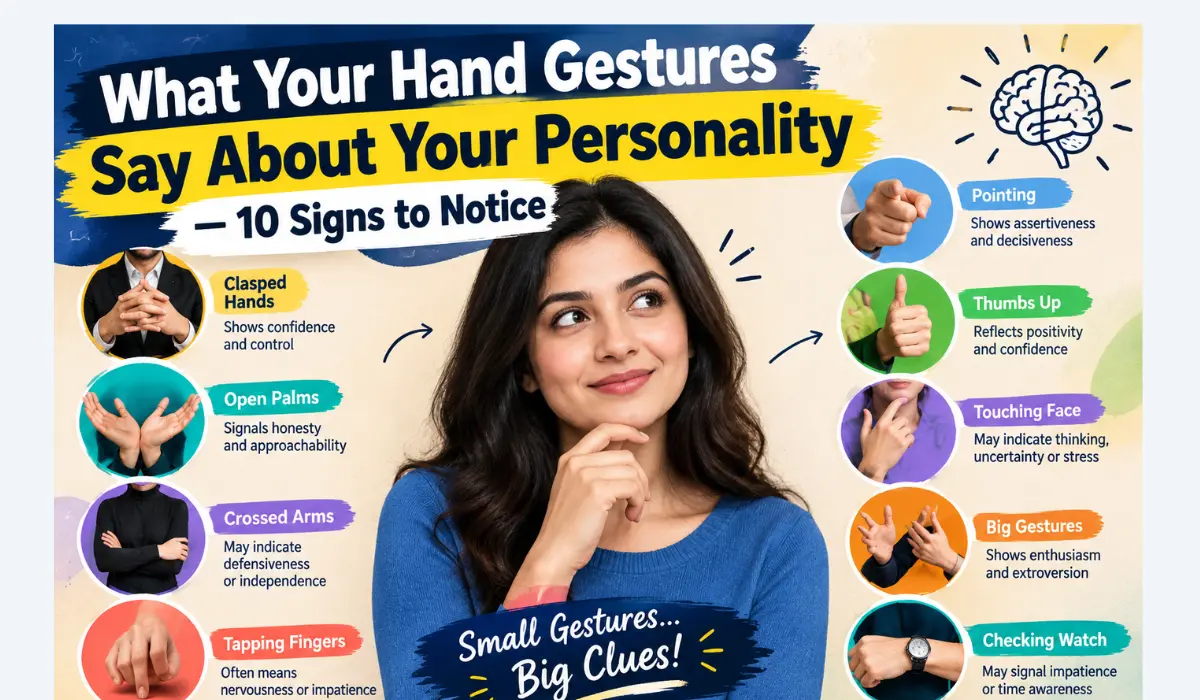
What Your Hand Gestures Say About Your Personality — 10 Signs to Notice
Watch anyone talk for more than thirty seconds and you’ll notice it: hands moving before the sentence even finishes forming. Fingers tapping mid-thought. Palms opening when someone’s trying to win you over, or disappearing into pockets when they’re not. We rarely notice our own hands doing this — but other people notice constantly, and so do you, even if you’ve never consciously clocked it.
Body language experts — including former FBI counterintelligence agent Joe Navarro and communication researcher Dr. Carol Kinsey Goman — have spent decades studying exactly what our hands give away that our words don’t. The short version: your hands are, in Navarro’s words, remarkably honest transmitters of what’s actually going on inside you, even when your mouth is saying something else entirely.
Here are 10 real, expert-backed hand gestures worth paying attention to — in yourself and in everyone around you.
What Do Hand Gestures Really Reveal?
- Open palms generally signal honesty, openness, and a desire to connect — it’s one of the oldest trust signals in human communication.
- Hidden hands (in pockets, under a table, behind the back) often indicate discomfort, guardedness, or something being withheld.
- Steepling fingers (fingertips touching, forming a little “church steeple”) is widely read as a confidence and authority signal.
- Clenched hands, despite sometimes looking composed, are frequently identified by researchers as a sign of frustration or suppressed negative emotion.
- Talking with your hands a lot isn’t nervous energy — psychologists say it actually helps organize and strengthen your own thinking as you speak.
- Self-touching gestures (touching the face, neck, or ears) are commonly linked to stress, self-soothing, or discomfort.
- None of this is an exact science. Body language experts are consistent on one point: read gestures as patterns and clusters, not single “gotcha” signals — and always in context.
Now let’s go through the 10 signs in detail.
1. Open Palms — The Universal Trust Signal
When someone talks to you with palms visible and slightly open, they’re using one of the most consistent honesty signals across human cultures. According to Joe Navarro’s research on nonverbal communication, we instinctively read open palms as a sign someone has “nothing to hide” — a signal so old it likely predates spoken language itself.
What it suggests: openness, honesty, and an active attempt to connect or persuade.
2. Hidden or Pocketed Hands — The Guarded Signal
The flip side: hands tucked into pockets, hidden under a table, or held behind the back. Body language researchers consistently associate hidden hands with discomfort, low confidence in the moment, or a desire to hold something back — even if the person isn’t consciously aware they’re doing it.
What it suggests: guardedness, hesitation, or reduced comfort in the current situation.
3. The Steeple — The Confidence Signal
Fingertips touching, palms apart, forming a little steeple shape — this is a gesture body language experts consistently link to confidence and quiet authority. It shows up often in leadership settings, negotiations, and moments when someone genuinely believes what they’re saying. A close cousin, sometimes called the “basketball steeple,” involves the hands held further apart as if holding an invisible ball — often used by people listening more than speaking.
What it suggests: self-assurance, conviction, and a comfortable sense of authority.
4. Clenched Hands — The Hidden Frustration Signal
This one surprises people. A person sitting with hands clenched together, sometimes even smiling, can look composed and confident at first glance. But research by negotiation experts Nierenberg and Calero, widely cited in body language literature, found clenched hands are frequently a frustration gesture — signaling the person is holding back a negative or anxious feeling rather than expressing calm confidence. Notably, the higher the clenched hands are held, the stronger the underlying negative mood tends to be.
What it suggests: suppressed frustration or anxiety, even when the rest of the expression looks calm.
5. Talking With Your Hands — The Thinking-Out-Loud Signal
If you’ve ever been teased for talking with your hands, here’s some good news: according to the Association for Psychological Science, hand gestures while speaking genuinely help people organize and strengthen their thinking in real time — they’re not just nervous filler. Communication expert Dr. Carol Kinsey Goman describes gesture as directly linked to speech, actively powering up the speaker’s thought process, not just decorating it.
What it suggests: an expressive communicator whose thinking and speech are tightly connected — not a lack of composure.
6. Touching the Face or Neck — The Self-Soothing Signal
Rubbing the neck, touching the forehead, or pulling at an earlobe are grouped by body language researchers as “adaptors” — self-soothing gestures that surface when someone feels stress, discomfort, or uncertainty. Covering or touching the mouth while speaking is sometimes specifically read as an unconscious attempt to hold back words.
What it suggests: internal stress, hesitation, or discomfort with what’s being discussed.
7. The Modified Point — The Authority-Without-Aggression Signal
Instead of the classic extended-finger point — which Allan and Barbara Pease, well-known body language authors, describe as functioning almost like a symbolic club — some speakers press their thumb against a curled index finger and “point” with that unit instead. It’s a small adjustment that experts say projects conviction and authority without the aggressive edge of a direct finger-point.
What it suggests: a deliberate communicator who wants to seem assertive without appearing confrontational.
8. Mirrored Handshake — The Social-Awareness Signal
A firm handshake that naturally mirrors the other person’s grip and pace, paired with steady eye contact, reflects social attunement — someone reading and matching the room rather than dominating or under-committing to the interaction. Psychology Today’s body language coverage notes that greeting gestures vary significantly by culture, so this signal always needs context — a handshake isn’t even the default greeting everywhere.
What it suggests: social awareness and comfort adjusting to the person or situation in front of them.
9. The Palm-Down Gesture — The Control Signal
Gesturing with palms facing downward, especially while making a point, tends to read as an assertion of control or certainty — the speaker is “settling” the conversation rather than opening it up for discussion. It’s common in moments of instruction or strong conviction.
What it suggests: a need for control, certainty, or closure in the conversation.
10. Restless or Fidgeting Hands — The Overload Signal
Constant small movements — tapping, fiddling with an object, adjusting clothing — are typically read as a sign of internal restlessness, impatience, or an overstimulated nervous system in that moment, rather than a fixed personality trait. This is one of the clearest examples of why context matters: someone fidgeting during a stressful meeting isn’t necessarily an anxious person in general — they may just be having a stressful five minutes.
What it suggests: temporary overstimulation, impatience, or discomfort — best read alongside the actual situation, not in isolation.
An Important Caveat Before You Start “Reading” Everyone
It’s tempting to treat this list like a cheat code for instantly decoding anyone. Body language experts are firm on one point: no single gesture is a reliable verdict on its own. Context, culture, and clusters of behavior matter far more than any one hand movement in isolation. Someone touching their neck might be stressed — or their collar might just be itchy. The real skill body language researchers emphasize isn’t spotting one gesture; it’s noticing patterns that repeat, and reading them alongside tone, facial expression, and situation.
Frequently Asked Questions
Can hand gestures really reveal personality traits?
Body language experts believe hand gestures reveal a lot about a person’s in-the-moment emotional state and communication style, which over time can reflect broader personality patterns. However, no single gesture should be treated as a definitive personality “test” — context and repeated patterns matter far more than isolated movements.What does it mean if someone talks with their hands a lot?
According to psychologists, gesturing while speaking helps organize thought and strengthen communication — it’s linked to expressive, actively-thinking communicators rather than nervousness or lack of composure.What does hiding your hands in body language mean?
Hidden hands — in pockets, under a table, or behind the back — are commonly associated with discomfort, guardedness, or a desire to hold something back, according to body language researchers.Is body language reading scientifically accurate?
Body language patterns are grounded in real behavioral research, but experts caution against treating any single gesture as definitive proof of a trait or intention. The most reliable approach is looking at clusters of consistent behavior in context, not one gesture in isolation.What’s the most trustworthy hand gesture?
Open, visible palms are widely regarded by body language experts as one of the oldest and most consistent honesty and openness signals across human communication.
Key Takeaways
- Hands are described by body language experts as some of the most honest, hard-to-fake transmitters of emotion we have.
- Open palms and steepled fingers tend to signal openness and confidence; hidden hands and clenched fists often signal discomfort or suppressed frustration.
- Talking with your hands is a sign of active, expressive thinking — not a lack of composure.
- Self-touching gestures (face, neck, ears) are typically stress or discomfort signals, not fixed personality traits.
- Always read gestures in clusters and context — one isolated movement rarely tells the whole story.
This article draws on established body language and communication research for general insight and entertainment purposes. It is not a substitute for professional psychological assessment.
You might also like
For more real, engaging lifestyle and self-improvement reads, check out more stories in our Lifestyle section on Writer Sahibaa.