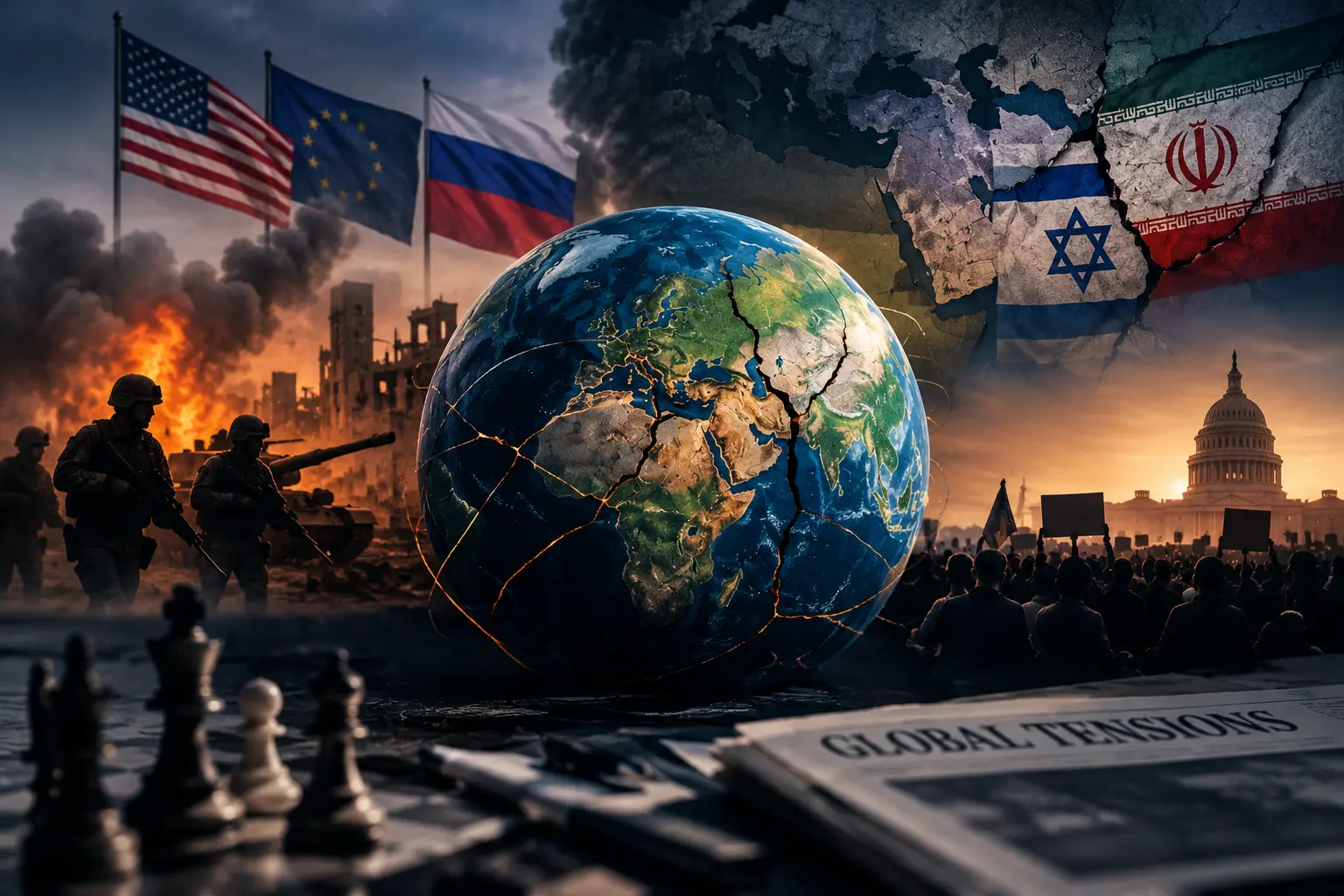
Why Is the World Becoming More Unstable? The Conflicts and Tensions Explained
Last updated: 17 October 2026
The world feels more unstable because wars are more numerous, last longer, spread across borders more easily and are harder to end, while the treaties and institutions that once held them back are weakening. The Institute for Economics & Peace (IEP) reports in its 2026 Global Peace Index that global peacefulness has fallen for the 12th year in a row, and that there are more active state-based conflicts than at any point since the end of the Second World War.
If the news has felt heavier lately, the data says you are not imagining it. This guide explains what is driving the instability, which conflicts matter most right now, how it touches everyday life, and where the genuine bright spots are. Every major figure comes from a named, authoritative source, linked at the end.
Key Takeaways
- Peace is declining on a measurable scale. The Global Peace Index shows 99 of 163 countries became less peaceful in the past year, and 119 are less peaceful than in 2008.
- Wars are harder to end. The share of conflicts ending in a peace agreement fell from 23% in the 1970s to about 4% in the 2010s.
- Rearmament is accelerating. World military spending hit $2.89 trillion in 2025, its 11th straight annual rise, according to SIPRI.
- Nuclear guardrails are thinning. The last major US–Russia arms treaty, New START, expired in February 2026 with no replacement.
- The Iran war is the biggest live shock. It began on 28 February 2026 and has disrupted the Strait of Hormuz, which normally carries about one-fifth of the world’s oil and gas.
- It is not all bad news. Forced displacement fell in 2025 for the first time in a decade, and deaths from terrorism are at their lowest since 2008.
Is the World Really Less Stable, or Does It Just Feel That Way?
It is a fair question, because news cycles can distort perception. So start with measurement rather than mood.
The Global Peace Index, produced by IEP in Sydney since 2007, scores 163 countries (99.7% of the world’s population) using 23 indicators across three areas: societal safety and security, ongoing conflict, and militarisation. The 2026 edition, released in June, found:
- Global peacefulness deteriorated by 0.7% in the past year, the 12th consecutive decline.
- There were 61 active state-based conflicts in 2024, roughly double the number 15 years earlier.
- Just over 181,000 people died in violent conflict in 2025. That is below the 2023 peak of more than 309,000, but still the second-highest toll since the index began.
- Twenty countries each recorded more than 1,000 conflict deaths in a single year, up from eight in 2008.
There is an honest caveat. Not every measure of violence is worsening. The index notes that homicide rates and perceptions of crime have improved over the long run, and terrorism deaths fell to their lowest level since 2008. The decline is driven mainly by armed conflict between and within states, not by everyday crime.
7 Reasons the World Feels More Unstable
1. Wars last longer and rarely end cleanly
Historically, wars ended in one of two ways: someone won, or both sides signed a deal. Both outcomes have become rarer. IEP’s data shows conflicts ending in a peace agreement dropped from 23% in the 1970s to about 4% in the 2010s, while those ending in clear victory fell from 49% to 9%.
The result is a world of frozen or grinding wars. Russia’s invasion of Ukraine is now in its fifth year, Sudan’s civil war began in April 2023, and Myanmar’s conflict has run since the 2021 coup.
2. Conflicts spread and pull in outsiders
Most modern wars are no longer purely domestic. “Internationalised” civil wars, where foreign states back one side, have risen by more than 175% since 2010. The number of countries involved in at least one external conflict over the past five years climbed from 59 in 2008 to 103 today.
IEP identifies eight conflict clusters worldwide. The Horn of Africa is the clearest example: Sudan, Ethiopia, Eritrea, Somalia and South Sudan are linked by refugee flows, gold smuggling, outside sponsors and competition for Red Sea ports. Illicit economies make it worse. Drug revenues in five major conflict-affected states rose from about $14 billion in 2015 to $59 billion in 2024, which means some wars can partly pay for themselves.
3. The global power balance is shifting
IEP calls the current era the “Great Fragmentation”, the third major geopolitical period of the past 50 years after the Cold War and the post-1990 globalisation boom. The number of middle powers has grown from nine to 16 since 1991, and many are less tightly aligned with Washington than older middle powers such as Australia.
More capable players are not automatically a problem. But IEP argues that with weaker multilateral institutions, tripled trade restrictions and heavier military spending, there are fewer shared rules for managing disputes. Note that this “risk exceeds the Cold War” judgement is IEP’s analysis, not a universally accepted conclusion.
4. Rearmament is up and arms control is down
The Stockholm International Peace Research Institute (SIPRI) reports that world military expenditure reached $2,887 billion in 2025, up 2.9% in real terms and equal to 2.5% of global GDP. The United States, China and Russia accounted for 51% of the total. China spent $336 billion, and India, the fifth-largest spender, raised its budget by 8.9% to $92.1 billion.
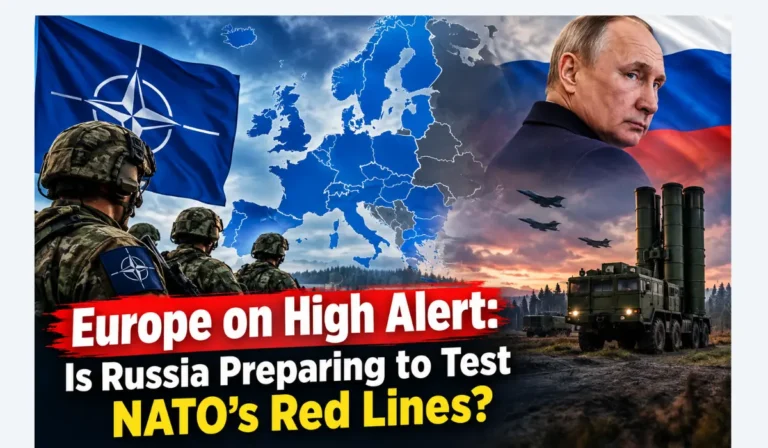
Europe is a major driver. IEP notes European NATO members raised defence spending by about 20% in 2025, and at the 2025 NATO summit members committed to reach 5% of GDP on defence and security by 2035.
The nuclear picture is more worrying. SIPRI’s Yearbook 2026 estimates about 12,187 nuclear warheads worldwide in January 2026, notes that all nine nuclear-armed states are modernising their arsenals, and records that New START expired in February 2026 without a successor. A 2026 review conference of the Non-Proliferation Treaty also ended without a final document.
5. Chokepoints turn regional wars into global shocks
The Strait of Hormuz is the textbook case. When shipping through it is disrupted, the effect shows up in fuel, fertiliser and freight prices thousands of kilometres away. Houthi attacks on Red Sea shipping, ongoing since late 2023, have done something similar to another key trade route.
IEP also warns of food effects. Gulf states supply roughly 45% of the world’s sulphur and 50% of its urea, both key for fertiliser, so disruption during the 2026 planting season could hit harvests in South Asia and East Africa in late 2026 and early 2027.
6. Drones and AI are changing the speed of war
IEP’s report finds recorded drone strikes rose roughly 115-fold between 2018 and 2025, and that 565 different armed groups carried out at least one drone attack in that period. It also cites cases where AI-assisted targeting has cut the time between identifying and striking a target to seconds, and raises concerns about shrinking human oversight.
Governance has not kept pace: of 193 UN member states, 118 take part in none of the seven leading AI governance initiatives IEP tracked. Treat the “seconds” figures as examples of the fastest systems, not as an average for all military operations.
7. Political strain inside countries
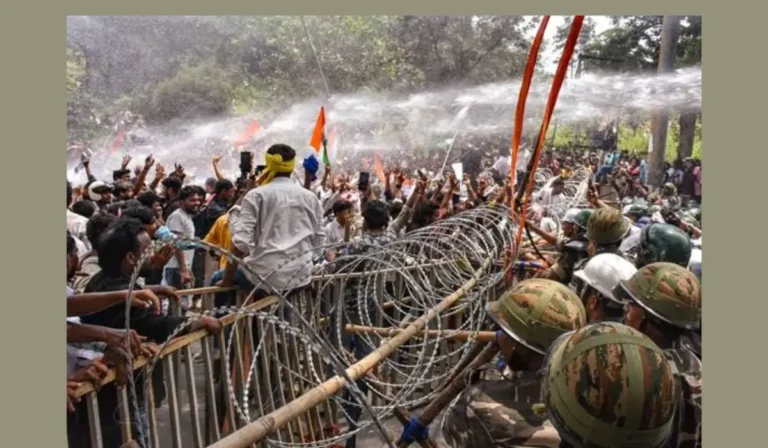
Instability is not only about wars between states. The 2026 index records the sharpest year-on-year fall in political stability in the United States since the index began (the US now ranks 134th), youth-led protests that brought down a government in Nepal in September 2025, and large anti-austerity protests in France and Argentina. These are very different situations, but they share a theme: pressure on public trust at a time when governments are also spending more on security.
Major Flashpoints to Watch (as of 17 October 2026)
| Flashpoint | What is happening | Why it matters globally |
|---|---|---|
| Iran war and Strait of Hormuz | War began 28 February 2026. A ceasefire in April and a June memorandum both collapsed. Indirect talks continue but are stalled; Al Jazeera reports crude flows through the strait were about 40% below normal in early October. | Oil and gas prices, shipping insurance, fertiliser supply |
| Russia–Ukraine | War is in its fifth year. US-brokered talks broke off in February; Washington is now proposing technical-level trilateral talks by end-October, AFP reported, though Moscow’s territorial demands remain the main obstacle. | European security, NATO spending, energy and grain markets |
| Sudan | Civil war since April 2023 with an estimated 150,000 deaths. Famine confirmed in several regions. | The world’s most severe humanitarian crisis per IEP; spillover across the Horn of Africa |
| Israel, Gaza and Lebanon | Gaza’s October 2025 ceasefire has been fragile, and fighting in Lebanon reignited in 2026. | Regional escalation risk, Red Sea shipping |
| South Asia | A four-day India–Pakistan military clash in May 2025 was the most serious between the two since 1971. Pakistan–Afghanistan border tensions have also risen. | Two nuclear-armed neighbours; South Asia had the largest regional decline in the 2026 index |
| East Asia | China’s military activity around Taiwan and in the South China Sea increased, including its largest show of force in East Asian waters in December 2025. | Global semiconductor supply and Pacific trade |
For the Iran war specifically, the International Crisis Group’s Global Watch is a reliable, regularly updated tracker.
How Instability Affects Everyday Life
Wars feel distant until the bill arrives. IEP estimates the global economic impact of violence at $21.8 trillion in 2025, or 10.5% of world GDP, about $2,657 per person. Most of that is military and internal security spending.
For ordinary households, the channels are mostly indirect:
- Energy and fuel prices move with disruptions at chokepoints like Hormuz.
- Food prices can rise when fertiliser supply is squeezed.
- Government debt gets harder to manage in fragile economies. IEP highlights that Pakistan, Egypt and Kenya face $5.1 billion in debt rollovers in November and December 2026.
- Public budgets shift toward defence, which can mean less room for health, education or climate spending.
For comparison, IEP puts global spending on peacebuilding and peacekeeping at $49.2 billion, about 0.5% of military spending.
The Other Side: Signs of Progress
A balanced picture needs the good news too.
- Displacement fell. UNHCR reports 117.8 million forcibly displaced people at the end of 2025, down from 123.2 million, the first decline in a decade. Much of the drop came from returns, though UNHCR warns many returns happened in difficult conditions. And new displacement from the Iran war is already adding to the 2026 total.
- Terrorism deaths fell to their lowest level since 2008, per IEP, although the Sahel remains severely affected.
- Some old conflicts are cooling. Armenia and Azerbaijan signed a peace agreement in August 2025, and the PKK announced it would end armed operations against Türkiye in 2025.
- Syria began a political transition after more than 13 years of civil war, with over a million refugees starting to return by late 2025.
What Could Make the World More Stable?
No single fix exists, and anyone promising one is overselling. The research points to several levers:
- Diplomacy that ends wars rather than freezing them. IEP estimates that successful diplomacy ending the Iran war could be worth about $2.2 trillion to the global economy compared with a renewed escalation.
- Rebuilding arms control. With New START gone, even basic data-sharing and communication channels between nuclear powers matter.
- Rules for military AI. Broader participation in AI governance could reduce the risk of fast, poorly supervised escalation.
- Investing in “Positive Peace”. IEP’s term for the attitudes, institutions and structures that sustain peaceful societies, such as functioning courts, low corruption and fair resource distribution.
- Stronger conflict prevention funding, given how small peacebuilding budgets are compared with military ones.
It is worth being honest about limits: these are research-based recommendations, not guarantees, and each depends on political will from governments that currently disagree sharply.
How to Follow World Events Without Burning Out
- Pick two or three primary sources (for example the Crisis Group, SIPRI and UNHCR) rather than endless social feeds.
- Check trackers weekly, not hourly. Situations like the Iran talks change daily but rarely resolve daily.
- Separate data (casualties, spending, displacement) from commentary, and read both with care.
Frequently Asked Questions
Is the world less peaceful than it used to be?
By the Global Peace Index’s measure, yes. Peacefulness has deteriorated in 12 consecutive years, and 119 of 163 countries are less peaceful than in 2008. The decline is driven mostly by armed conflict, not by crime.
Which countries are the least peaceful?
In the 2026 Global Peace Index, Russia ranks last, followed by Sudan, the Democratic Republic of the Congo, Ukraine and Israel. Iceland is the most peaceful country, followed by New Zealand, Switzerland, Slovenia and Ireland.
Is a third world war likely?
The reports cited here do not predict one. What they describe is a compounding risk: more wars, weaker arms control, more countries drawn into others’ conflicts, and faster military technology. That raises the chance of miscalculation, but outcomes depend on choices governments make.
How does the Iran war affect people outside the Middle East?
Mainly through energy, shipping and food. Roughly one-fifth of global oil and gas normally passes through the Strait of Hormuz, and Gulf states are major fertiliser suppliers. IEP estimates the war’s first-year global GDP cost at about 0.6%, but with the heaviest burden falling on fragile economies.
How many people are displaced by conflict worldwide?
UNHCR counted 117.8 million forcibly displaced people at the end of 2025, about one in every 70 people on Earth. That included 41.6 million refugees and 68.7 million people displaced inside their own countries.
Why are military budgets rising so fast?
Governments are responding to active wars (especially in Ukraine and the Middle East), to fears of wider conflict, and to a less predictable security environment. SIPRI notes that growth will probably continue through 2026 and beyond.
Conclusion
The world is becoming more unstable not because of one crisis but because several are reinforcing each other: longer wars, wider alliances and proxies, rising arms budgets, thinner nuclear guardrails, vulnerable trade routes and fast-moving military technology. The Iran war and the continuing war in Ukraine are the two largest pressure points right now.
But the same data shows that instability is not destiny. Displacement fell last year, several old disputes have eased, and the economic case for diplomacy is large. Understanding how the pieces connect is the first step to reading the news with clarity rather than anxiety.
Situations described here, especially the Iran war and Russia–Ukraine talks, are changing quickly. Figures reflect the sources as of 17 October 2026.