
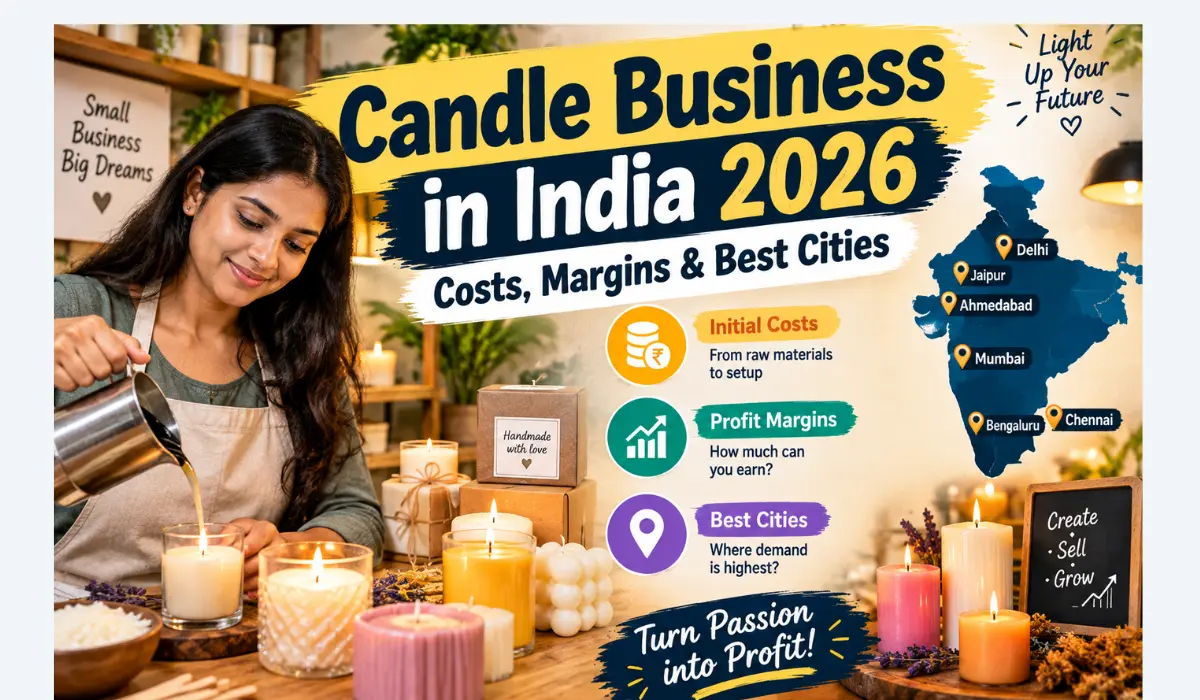
Why the Candle Business Is Booming: From a Small Idea to a Multi-Million-Dollar Industry
Yes, the candle business can be a profitable business in India. A scented candle that costs roughly ₹150–₹300 to make can sell for ₹600–₹1,800, giving a gross margin of about 55–78% (a candle-supplies retailer’s estimate). Your take-home profit is lower once ads, packaging, shipping and your own time are counted. Demand peaks around Diwali, wedding season and Christmas.
It’s the festive season. Diwali is close, and people are already searching for gifts that feel thoughtful but don’t cost a fortune. A scented candle in a nice jar is one of the safest answers, and designer scented candles are now easy to find from small online brands as well as big names.
That is the whole story of this industry in one scene. A small, low-cost product that looks premium, fits every budget and suits every festival.
In this guide, I’ll walk you through the market size, the real cost of making a candle in India, selling prices and margins, who buys what, which cities to start with, and what global brands can teach Indian makers.
Key takeaways
- The global candle market is estimated at roughly USD 9–15 billion depending on the research firm.
- India’s candle market is estimated at USD 360–440 million in 2025 by two of the more conservative firms. Estimates vary widely.
- Gross margins of 55–78% are possible, but net margins are usually 25–60%, depending on your sales channel.
- Start small: ₹5,000–₹30,000 can get a home-based business going.
- Your biggest sales windows are Diwali, wedding season, Christmas and Valentine’s Day.
How big is the candle industry, really?
Different research firms give very different numbers, so here is the honest picture.
| Market | Estimate | Source |
|---|---|---|
| Global candles | USD 8.98 billion (2025) | Fortune Business Insights |
| Global candles | USD 14.8 billion (2025) | Grand View Research |
| India candles | USD 360.6 million (2025) | IMARC Group |
| India candles | USD 437.8 million (2025) | Market Research Future |
Why the gap? Each firm counts different products and price tiers. Treat these as a range, not a fixed fact.
What every report agrees on is the direction. Growth is steady, driven by home décor, wellness, gifting and online shopping. Grand View Research also notes that premium scented candles hold the largest share of the global scented candle market. That tells you where the money sits.
In India specifically, IMARC points to rising incomes, e-commerce reaching smaller cities, and demand for soy, coconut and other natural waxes. Big players are noticing too. In July 2025, ITC launched its aromatherapy brand Pranah, which includes scented candles.
Smaller online-first brands are entering as well. Muse & Hues Candles is one example, selling unique, designed and customizable candles directly to customers. That is a good sign for the category. It is also a warning: competition is rising.
Why are candles selling so well?
Four reasons keep showing up.
- Home is now a mood.
People want their rooms to feel calm, not just look neat. - Wellness.
Lavender for sleep and eucalyptus for stress are the usual first purchases. It’s part of a wider shift towards slow, mindful routines, the same mindset behind ideas like fashion meditation, where everyday choices become moments of calm. - Gifting culture.
India gifts more than almost any market. A candle works for a colleague, a bride, a host or a neighbour. That’s why more brands now offer ready-to-give candle gift hampers around festivals and weddings. - Low entry cost.
You can start at home, test with friends, and sell on Instagram.
Types of candles and who buys them
| Candle type | Best occasion | Target audience | Indicative retail price* |
|---|---|---|---|
| Tealight / votive | Diwali, puja, home décor | Every household, event decorators | ₹10–₹60 each |
| Pillar candle | Weddings, festive tables | Wedding planners, hotels, cafés | ₹150–₹600 |
| Soy jar candle (150–250 g) | Housewarming, birthdays, self-care | Women 22–40, young professionals | ₹500–₹1,200 |
| Luxury / ceramic-vessel candle | Corporate gifts, anniversaries | Premium gifters, HR teams | ₹1,200–₹2,500+ |
| Shot-glass / mini candle | Wedding favours, return gifts | Wedding hosts, corporate events | ₹60–₹200 |
| Gift box (candle + diffuser or melts) | Diwali, Valentine’s Day, Raksha Bandhan | Gifters with ₹1,000–₹3,000 budgets | ₹1,200–₹3,500 |
*These are indicative ranges I’d use for planning, based on the price points quoted by Indian suppliers and brands. Check your local market before fixing your own prices.
Design-led products are growing fastest in this list. Floral bouquet candles, which look like flowers but never wilt, are a good example of a candle that works as both décor and a gift.
What does it cost to make one candle in India?
Let’s take a 200 g soy jar candle. Raw-material ranges below come from Indian suppliers (wax ₹300–₹600 per kg, fragrance oil ₹3,000–₹5,000 per litre, wicks ₹5–₹30, jars ₹10–₹150). The figures in the table are my illustrative mid-points, not a quote.
| Item | Illustrative cost |
|---|---|
| Soy wax (about 175 g) | ₹80 |
| Fragrance oil (about 8% load) | ₹60 |
| Cotton wick + sticker | ₹13 |
| Glass jar with lid | ₹65 |
| Label | ₹5 |
| Box and packing | ₹30 |
| Total cost of goods | ≈ ₹253 |
A candle-supplies retailer estimates the total cost of a premium 200 g candle at ₹180–₹415, with selling prices from ₹600 to ₹1,800. Note that this source also sells supplies, so use it as a guide rather than a guarantee.
Buying in bulk helps. The same retailer says bulk purchasing cuts material costs by 15–25%.
Selling price, margin and real profit
Suppose you sell that ₹253 candle at ₹699.
- Gross profit: ₹699 − ₹253 = ₹446
- Gross margin: about 64%
That looks wonderful. Now add the costs people forget:
- Shipping and returns
- Instagram or Google ads
- Payment gateway or marketplace fees
- Wasted wax while testing
- Your own time
Once these are counted, margins shrink. One Indian supplier report puts net margin at 17–27% for wholesale, 36–57% for direct-to-consumer online sales and 40–65% for premium positioning. Another guide warns that net margins can land at only 18–35% when you buy tiny quantities of raw material. Treat all such figures as estimates.
My advice: price for the full picture. If you only count wax and jar, you will feel rich and end up broke.
A note on GST
From 22 September 2025, candles (HSN 3406) are generally listed at 5% GST, and handcrafted candles fall under a handicraft entry as well. Rates and conditions can change, so confirm with your CA before you start invoicing.
How much money do you need to start?
| Level | Investment | What it covers |
|---|---|---|
| Hobby | ~₹5,000 | 2 kg wax, a few fragrances, wicks, 10–15 jars |
| Gifting / bulk orders | ₹15,000–₹30,000 | Larger stock, better packaging |
| Premium D2C brand | ₹40,000–₹80,000 | Branding, custom boxes, ads, photography |
Source: a candle-supplies retailer’s 2026 guide. Add money for a small test batch and a few burn tests before you launch.
Best time to sell: the Indian candle calendar
- September–November: Diwali is the biggest gifting window. Start production early.
- October–February: wedding season. Think return gifts, décor and table candles.
- December: Christmas and New Year.
- February: Valentine’s Day.
- August: Raksha Bandhan gift boxes.
- Year-round: wellness and self-care buyers.
Which cities should you target first?
I could not find public city-level candle sales data for India, so treat this as practical guidance, not a statistic.
- Delhi NCR, Mumbai, Bengaluru: the highest number of premium gifters and corporate buyers. Also the toughest competition.
- Hyderabad, Pune, Chennai: growing young-professional markets with strong online shopping habits.
- Jaipur, Udaipur, Goa: destination weddings and hospitality. Great for pillar candles, favours and décor.
- Chandigarh, Ludhiana, Amritsar: wedding-heavy markets with strong gifting habits. Ideal for return gifts and festive hampers.
- Tier-2 and Tier-3 cities: IMARC notes that e-commerce has made premium candles more accessible beyond big cities. Instagram and WhatsApp selling work well here.
Simple rule: sell where you live first. You can deliver quickly, hear feedback, and build reviews before you ship nationwide.
What Indian makers can learn from foreign markets
1. Design matters as much as scent.
Europe leads the global market by revenue share in some reports, and it is home to houses like Diptyque and Trudon. Their appeal is as much about the vessel and packaging as the fragrance. A 2026 retailer sales report says Diptyque Baies remains the most purchased single luxury candle fragrance in its data.
2. One hero scent can build a brand.
The same retailer notes Trapp rode one scent (Orange Vanilla No. 4) and Flamingo Estate rode Heirloom Tomato. A single unusual, memorable candle can beat a range of ten average ones.
3. Digital-first brands win young buyers.
In 2023, Curio Brands acquired Otherland, a brand known for a strong online presence and artistic packaging aimed at millennials and Gen Z.
4. Emotional storytelling sells.
Homesick makes candles based on memories of places, and Boy Smells offers gender-neutral scents in bold vessels.
5. Scent trends are shifting.
Reports for 2026 point to smoke, leather and suede going mainstream, white florals leading repeat purchases, spa-like scents such as eucalyptus, and less-sweet “grown-up” gourmands like chai and sandalwood. Sculptural, art-like candle shapes and reusable vessels are also rising.
6. Fast growth in Asia-Pacific.
One market report puts Asia Pacific as the fastest-growing region for scented candles. Only one firm makes that claim here, so treat it as a signal, not a promise.
Opportunities I’d look at in India
- Indian-inspired scents: kesar, chai, mogra, sandalwood, rose, petrichor. Familiar smells feel personal.
- Reusable vessels: brass, terracotta or ceramic jars that people keep after the candle burns out.
- Wedding favour kits: mini candles with custom labels.
- Corporate gifting: bulk orders with company branding.
- Sculptural and festive designs: diya-inspired, lotus or geometric shapes.
- Customization: personalized colours, fragrances and packaging help small brands stand out.
- Subscription boxes: a new scent each month, a model already suggested by market analysts.
- Wellness positioning: sleep, focus and calm collections, with honest claims (avoid promising medical benefits).
Common mistakes to avoid
- Skipping burn tests. Wrong wick size causes tunnelling or soot.
- Using too much fragrance oil. It hurts margin and can hurt burn quality.
- Ignoring safety. Use IFRA-compliant fragrance oils and add burning instructions on the label.
- One price for every channel. Keep separate retail and wholesale prices.
- Starting Diwali production too late.
- Selling on marketplaces before you have a brand identity.
Simple 7-step action checklist
- Choose one niche (gifting, wedding, wellness or luxury).
- Buy small test quantities of wax, wicks and two fragrances.
- Make 10 test candles and burn each fully.
- Calculate cost per candle including packaging and your time.
- Set retail and wholesale prices.
- Photograph well, launch on Instagram and WhatsApp, and collect reviews.
- Plan your next festive batch two months ahead.
Frequently asked questions
Is candle making profitable in India?
Yes, but profit depends on your channel and volume. Gross margins of 55–78% are quoted for premium scented candles, while net margins are commonly lower.How much does it cost to make a candle at home in India?
A basic scented jar candle can cost roughly ₹150–₹300 in materials and packaging, depending on wax, jar and fragrance.What is the best wax for beginners?
Soy wax is popular for clean burning and good scent throw. Paraffin is cheaper. Coconut wax is a premium choice.How much should I sell a candle for?
Many Indian brands price 200 g scented candles between ₹600 and ₹1,800. Choose a price that covers full costs and matches your positioning.When do candles sell the most in India?
Around Diwali, the wedding season, Christmas and Valentine’s Day.Do I need a licence to sell candles?
Rules depend on your business structure and turnover. GST registration may apply once you cross the threshold. Confirm with a CA or local authority.
Final thoughts
The candle business is not a get-rich-quick trick. It is a simple product with real demand, a low starting cost and lots of room for creativity.
The makers who last usually do three things well. They know their exact costs. They tell a clear story. And they plan around India’s festive calendar.
Start small. Test honestly. Then grow.
And if you’re a buyer rather than a maker, you can explore the full collection from Muse & Hues Candles for a Diwali gift, a wedding favour or something for your own space.
Disclosure: Muse & Hues Candles is a brand we’re connected with.
Need help writing product pages, blogs or brand copy for your candle brand? Explore more content guides on Writer Sahibaa.