
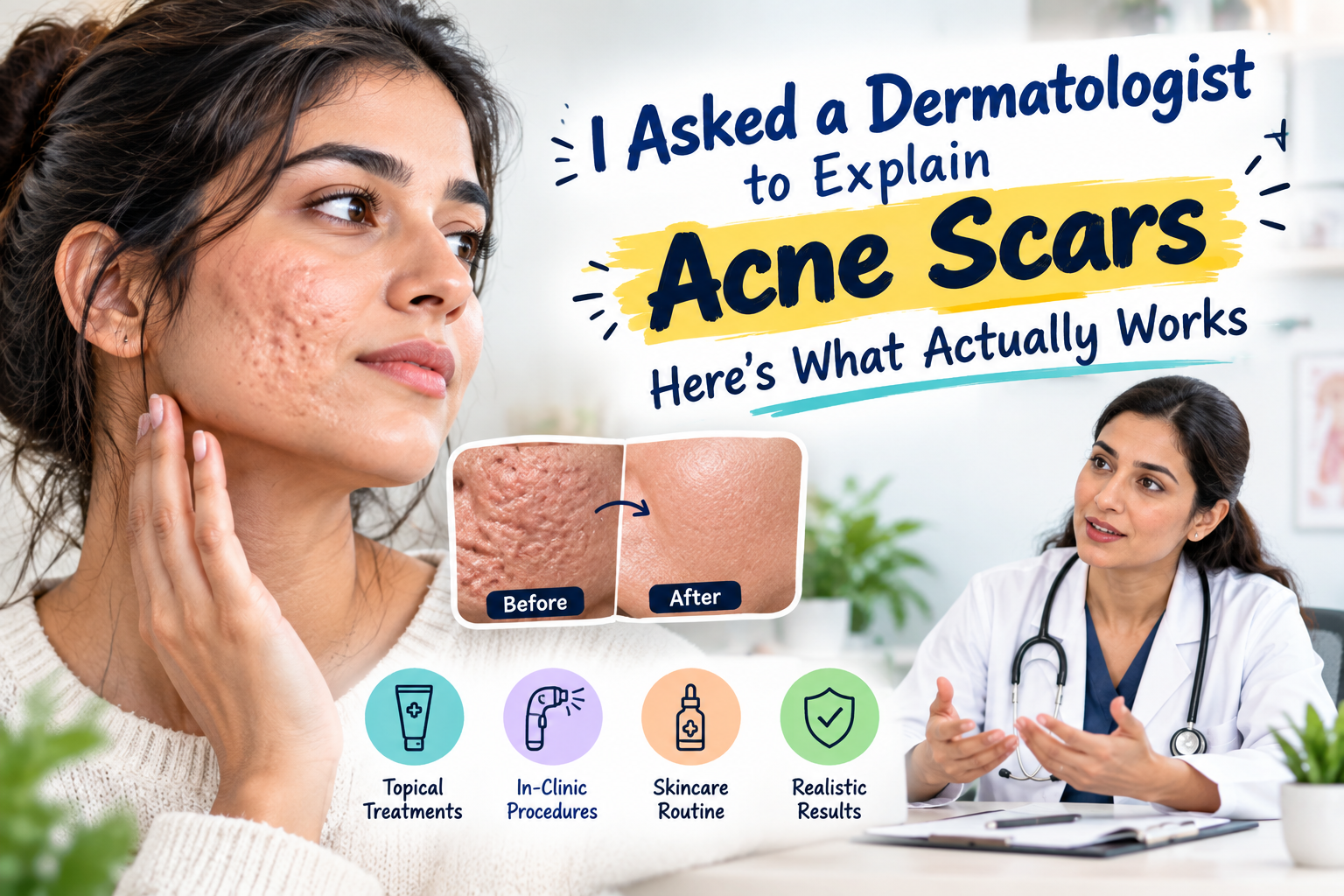
I Asked a Dermatologist to Explain Acne Scars — Here’s What Actually Works
If you’ve ever stood in front of a mirror tilting your face toward the light, trying to figure out whether that mark on your cheek is a scar or just a bad day — you already know that acne scars mess with more than your skin. They mess with your confidence.
Here’s the thing nobody tells you upfront: not all “acne scars” are the same problem, and that’s exactly why so many people spend money on treatments that don’t work for their type of scarring. A serum that smooths one kind of scar can do almost nothing for another. A laser that works wonders on fair skin can cause dark patches on deeper skin tones if it’s used carelessly.
So instead of another generic “10 tips for clear skin” list, this guide breaks acne scarring down the way a board-certified dermatologist actually thinks about it — what causes it, which type you probably have, what treatments have real clinical evidence behind them, and what’s realistic to expect.
Quick Answer: What Actually Works for Acne Scars
If you only read one section, read this one.
- Acne scars don’t disappear on their own. They can fade slightly over time, but true texture loss (pits, craters) needs an active treatment.
- The right treatment depends entirely on scar type. Ice pick, boxcar, rolling, and raised (hypertrophic/keloid) scars each respond differently.
- The strongest evidence exists for: subcision, microneedling (including RF microneedling), fractional laser resurfacing, chemical peels (like TCA CROSS), and dermal fillers — often used in combination, not alone.
- Combination therapy consistently outperforms single treatments in clinical studies, because it addresses more than one layer of the scar at once.
- Retinoids and vitamin C help with tone and mild texture, but they cannot fix deep, pitted scars — set realistic expectations here.
- Results take months, not days. Most in-office procedures need 3–6 sessions spaced weeks apart, with final results visible several months after the last session.
- A dermatologist’s assessment matters more than the product itself, because two people with “acne scars” can need completely opposite treatments.
Now let’s go deeper.
What Are Acne Scars, Really?
Acne scars form when inflamed breakouts — especially deep, cystic, or nodular acne — damage the collagen structure underneath the skin. When the skin heals, it doesn’t always rebuild that collagen evenly. Sometimes it makes too little (leaving a pit or dent). Sometimes it makes too much (leaving a raised bump).
According to the American Academy of Dermatology (AAD), acne scars are most common in people who’ve had moderate to severe acne, and while they can fade somewhat, they rarely disappear completely without treatment. This is important to hear early, because it reframes the goal: the aim isn’t to erase every trace, it’s to visibly and meaningfully improve texture and tone.
Why do some people scar more than others?
Not everyone with acne ends up with scarring, and dermatologists still don’t fully understand why. What’s well established is that risk goes up with:
- Deep, cystic, or nodular breakouts (rather than surface-level whiteheads)
- Delayed treatment of active acne
- Picking, popping, or squeezing pimples
- Genetics — a family history of scarring or keloids
- How long the skin stayed inflamed before it was treated
This is also why dermatologists push so hard on treating active acne early — the best scar treatment is often preventing new scars from forming in the first place.
The 4 Main Types of Acne Scars (And Why Type Matters)
Most people assume “acne scars” is one category. Clinically, it’s at least four very different categories, and mixing up the treatment approach is the single biggest reason people feel like “nothing works.”
| Scar Type | What It Looks Like | Cause | Best-Suited Treatments |
|---|---|---|---|
| Ice pick | Narrow, deep, pinprick-like holes, usually on the cheeks | Deep cystic acne that destroys tissue down to the dermis | TCA CROSS, punch excision, laser resurfacing (combination approach) |
| Boxcar | Wide, box-shaped depressions with sharp edges | Collagen loss from inflammatory breakouts | Dermal fillers, subcision, laser resurfacing, punch elevation |
| Rolling | Wave-like, shallow indentations with soft, undefined edges | Fibrous bands tethering skin to deeper tissue | Subcision (to release the tethering), followed by resurfacing |
| Hypertrophic / Keloid | Raised, firm, thickened scar tissue | Overproduction of collagen during healing | Corticosteroid injections, laser therapy, silicone sheeting |
There’s also a fifth, very common issue that people often mistake for scarring: post-inflammatory hyperpigmentation (PIH) — the dark or reddish mark that’s left behind after a pimple heals. This isn’t a true scar; it’s a pigmentation change, and it usually responds well to ingredients like vitamin C, niacinamide, azelaic acid, and sunscreen, without needing procedural treatment. Knowing the difference between PIH and an actual textural scar saves a lot of money and disappointment.
What Actually Works: Treatments Backed by Real Evidence
This is where most articles get vague. Here’s what dermatology research and clinical practice actually support, roughly ordered from least to most intensive.
1. Topical retinoids
Best for: mild texture irregularities and prevention, not deep scars. Retinoids increase cell turnover and stimulate collagen production over time. They’re genuinely useful as a long-term skin-quality tool and as part of a maintenance routine after procedures — but they will not fill in a boxcar or ice pick scar on their own.
2. Chemical peels
Best for: surface texture, mild boxcar scars, and pigmentation. Peels using glycolic, salicylic, or trichloroacetic acid (TCA) resurface the top layers of skin. A specific technique called TCA CROSS (Chemical Reconstruction of Skin Scars) is applied in a very focused way directly into ice pick and narrow boxcar scars, and it has solid evidence for improving these specific scar types.
3. Microneedling (including RF microneedling)
Best for: rolling scars and overall texture, especially on darker skin tones. Microneedling creates controlled micro-injuries that trigger the body’s own collagen production. Radiofrequency (RF) microneedling combines this with heat energy delivered deeper into the skin, and recent clinical reviews rank it highly for improving texture with relatively low risk of pigmentation changes — which matters a lot for people with medium to deep skin tones, who are more prone to post-procedure discoloration from aggressive lasers.
4. Laser resurfacing
Best for: boxcar and ice pick scars, overall skin resurfacing. This covers a range of devices — fractional CO2 lasers, Er:YAG lasers, and picosecond lasers. Ablative lasers (like CO2) remove the top skin layer to trigger fresh regrowth and are considered among the most effective options for textural scarring, though they come with more downtime. Non-ablative and fractional options offer gentler alternatives with shorter recovery, often at the cost of needing more sessions for the same result.
5. Subcision
Best for: rolling scars specifically. A needle is used just under the skin to break up the fibrous bands pulling the scar downward, releasing the tethering that causes the “rolling” look. This is often paired with a filler or your own fat/PRP injected into the released space to keep it from re-tethering.
6. Dermal fillers
Best for: boxcar scars, and patients who want quick, visible results. Hyaluronic acid–based fillers physically fill the depressed area. The effect is immediate, which makes it appealing, but it’s temporary — typically lasting months rather than years — so it’s often used alongside a longer-term treatment like subcision or laser.
7. Punch excision / punch grafting
Best for: deep, narrow ice pick scars that don’t respond to resurfacing. The scar tissue is surgically removed or replaced with a small skin graft, then allowed to heal. This is a more invasive, minor surgical option reserved for scars that resist other treatments.
8. PRP (Platelet-Rich Plasma)
Best for: boosting results when combined with microneedling or laser. PRP uses growth factors from your own blood plasma to accelerate healing and collagen production. Recent network meta-analyses of acne scar treatments have found that combining laser with PRP ranks among the most effective approaches for improving scar scores — reinforcing that combination therapy tends to outperform any single treatment used alone.
9. Treatment for raised (hypertrophic/keloid) scars
This is the outlier category, since these scars have too much tissue, not too little. Dermatologists typically use corticosteroid injections to flatten and soften the tissue, sometimes combined with laser therapy or silicone sheeting.
Which Treatment Fits Your Scar Type? A Simple Decision Guide
| If your scar is… | Start by asking about… |
|---|---|
| Deep and narrow (ice pick) | TCA CROSS or punch excision, often combined with laser |
| Wide with sharp edges (boxcar) | Fillers or subcision + laser resurfacing |
| Shallow and wavy (rolling) | Subcision first, then resurfacing |
| Raised and firm | Corticosteroid injections, possibly with laser |
| Just discoloration, no texture change (PIH) | Topical vitamin C, niacinamide, sunscreen — no procedure needed |
Most people have more than one scar type at once, which is exactly why dermatologists usually recommend combination therapy rather than a single fix. A 2024–2025 review of acne scar management from a panel of dermatologists and plastic surgeons with 20+ years of combined clinical experience concluded that treatment needs to be algorithmic — matched to each component of the scar — and that a patient-specific combination approach offers the best realistic chance of visible improvement.
Best Countries for Advanced Acne Scar Treatment
If you’re considering traveling for treatment or simply want to know where the most advanced acne scar technology and expertise are concentrated, here’s an honest, source-based comparison. No single country wins at everything — it depends on whether you’re prioritizing surgical precision, technology volume, affordability, or a conservative treatment style.
| Country | What It’s Known For | Good Fit If You Want |
|---|---|---|
| United States | Leads in dermatologic research, FDA-regulated devices, and board-certified specialist precision (via bodies like the AAD). Strong for surgical scar revision (punch excision, subcision) and doctor-led, procedure-specific care. | A research-backed, highly regulated, specialist-led approach — especially for complex or surgical cases |
| South Korea | Globally recognized for combining multiple technologies (laser + microneedling + fillers) in single sessions, high patient volume, and rapid adoption of new devices. Clinics in Seoul are especially known for “scar mapping” and multi-modal protocols. | Combination therapy, high procedure volume, and generally lower cost than Western clinics |
| Japan | Known for a conservative, gradual treatment philosophy focused on natural-looking results and skin preservation. | A slower, lower-downtime approach rather than aggressive resurfacing |
| Singapore | High medical regulation and safety standards, experienced aesthetic physicians, though a narrower range of clinics than Korea. | Safety-first, tightly regulated care |
| Thailand | Increasingly popular for affordable aesthetic dermatology, though technology adoption generally trails Korea. | Budget-conscious treatment as part of a broader skin-rejuvenation trip |
The honest takeaway: the United States remains the strongest choice if you want treatment grounded in rigorous research, FDA oversight, and specialist-led surgical precision — particularly for complex scarring that needs a tailored, procedure-specific plan rather than a one-size-fits-all package. South Korea currently leads on combination-technology volume and cost-efficiency for patients open to traveling. Wherever you go, verify that the provider is a board-certified dermatologist or plastic surgeon, not just a cosmetic technician — scar treatment is a medical procedure, not a spa service.
Common Mistakes People Make With Acne Scars
- Treating PIH like a scar. Spending on lasers for marks that would have faded with consistent vitamin C and sunscreen.
- Picking one treatment and expecting it to fix every scar type on the face. Most faces have a mix of scar types.
- Skipping sunscreen during treatment. UV exposure worsens pigmentation risk after peels, lasers, and microneedling — this single step can make or break your results.
- Judging results too early. Collagen remodeling takes months. Improvement at week 2 tells you almost nothing about the final result at month 4–6.
- Going for the most aggressive option first. Deeper doesn’t always mean better, especially for medium-to-dark skin tones, where aggressive ablative lasers carry a higher risk of post-inflammatory pigmentation if not handled by an experienced provider.
- Still actively picking at breakouts. New scars can form faster than old ones fade.
Supporting Your Skin Between Treatments
Procedures do the heavy lifting, but your daily skincare routine decides how well your skin holds onto those results — and how much new damage it avoids in the meantime. If you’re still figuring out the basics of a routine that actually supports healing skin (cleansing, barrier repair, sun protection), it’s worth spending time on the fundamentals before layering in actives. You can explore more skin and self-care guides in our Beauty section.
And because acne scarring is as much an emotional experience as a physical one, it’s worth pausing on the confidence side of this too — the quiet, daily habit of feeling okay in your own skin while you wait for results. If that resonates, our piece on mindful, intentional self-care routines is a gentle place to start.
Frequently Asked Questions
Can acne scars go away completely on their own?
No. They can fade somewhat over time, especially discoloration (PIH), but true textural scars — pits or raised tissue — don’t fully resolve without treatment.What is the single most effective treatment for acne scars?
There isn’t one “best” treatment for everyone. Clinical evidence consistently shows that combination therapy — for example, laser paired with PRP, or subcision paired with fillers — outperforms any single treatment used alone.How many sessions does acne scar treatment usually take?
Most in-office procedures (microneedling, laser, chemical peels) require 3–6 sessions spaced several weeks apart, with visible improvement building over months.Is microneedling or laser better for acne scars?
It depends on scar type and skin tone. Microneedling (especially RF microneedling) tends to carry a lower risk of pigmentation changes on darker skin tones, while laser resurfacing is often more effective for deeper boxcar and ice pick scars but carries more downtime and pigmentation risk if not done carefully.Do at-home devices and creams work for acne scars?
Retinoids and vitamin C can improve mild texture and tone over time, and they’re useful for prevention and maintenance, but they can’t fill in deep pits or release tethered rolling scars. Deep textural scars generally need an in-office procedure.Is it worth traveling abroad for acne scar treatment?
It can be, especially for combination-therapy protocols that are more widely available and lower-cost in destinations like South Korea. But the most important factor isn’t the country — it’s whether you’re being treated by a board-certified dermatologist or plastic surgeon with real experience in scar-specific procedures.
Key Takeaways
- Acne scars are not one condition — treatment has to match the specific scar type (ice pick, boxcar, rolling, or raised).
- The strongest, most evidence-backed results come from combination therapy, not a single miracle product.
- Retinoids and vitamin C help with prevention and mild texture, but deep scars need in-office procedures.
- Results take months to show fully — patience is part of the treatment plan.
- A dermatologist’s assessment of your specific scar type matters more than any single product or procedure name.
- Sun protection during and after treatment isn’t optional — it directly affects your final results.