The E20 Fuel Controversy: What Gadkari Says, What Car Owners Claim, and What Sourav Joshi Got Wrong
If you’ve filled petrol in India recently and noticed your mileage isn’t what it used to be, you’re not imagining things. And you’re also not alone in wondering why.
Over the past few months, India’s push toward E20 petrol — fuel blended with 20% ethanol — has turned into one of the most heated consumer debates in the country. On one side, you have Union Road Transport Minister Nitin Gadkari, publicly daring critics to name a single damaged car. On the other, you have vehicle owners, taxi associations, and a fast-growing protest movement claiming the opposite.
Caught in the middle of it all: India’s biggest vlogger, Sourav Joshi, whose viral claim about his Mercedes-Benz turned out to be more complicated than his first video suggested.
This article breaks down exactly what’s true, what’s disputed, and what you should actually do if you’re worried about your own car.
Quick Answer
E20 petrol is fuel blended with 20% ethanol and 80% petrol, rolled out nationwide as part of India’s ethanol-blending program to cut oil imports and support farmers. The government, backed by data from the Society of Indian Automobile Manufacturers (SIAM), says lab tests show only a 2–4% mileage drop and no widespread engine damage. Many vehicle owners disagree, reporting mileage drops far larger than that in real-world driving, and a citizen protest movement called the E20 Janta Party has gone viral demanding the choice to buy pure petrol again. YouTuber Sourav Joshi added fuel to the debate (no pun intended) when he claimed his Mercedes-Benz GLC’s mileage crashed from 17 kmpl to 5 kmpl — before retracting the claim and blaming an unrelated engine fault.
Table of Contents
- What Is E20 Petrol, Exactly?
- What Nitin Gadkari Has Been Saying
- What Car Owners Are Actually Claiming
- The Sourav Joshi Mercedes Incident: What Really Happened
- What Car Companies Are Saying
- The Jantar Mantar Protest and Tehseen Poonawalla
- E20 Janta Party: The New Protest Page Going Viral
- Gadkari vs Car Owners: Comparing the Two Sides
- What Does the Science Actually Say?
- Is Your Car Compatible With E20?
- What You Can Actually Do About It
- Myths vs Facts
- Key Takeaways
- Frequently Asked Questions
What Is E20 Petrol, Exactly?
E20 is petrol blended with 20% ethanol, an alcohol-based fuel typically made from sugarcane, maize, rice, or crop residue. India has been increasing its ethanol blend gradually — from E5, to E10, and now to E20 — as part of a national program to cut crude oil imports, reduce vehicular emissions, and boost farmer income.
Think of it like adding a natural, cheaper mixer to petrol. Ethanol burns cleaner than pure petrol, but it also carries slightly less energy per litre. That single fact — lower energy content — is the root of almost every argument in this entire controversy.
The government says the impact of that lower energy content is small. Many car owners say it isn’t small at all. Both of those claims are worth examining separately.
What Nitin Gadkari Has Been Saying
Nitin Gadkari, India’s Union Minister for Road Transport and Highways, has been the government’s most vocal defender of E20 fuel — and its most direct target for criticism.
Here’s a timeline of his key public positions:
- He has repeatedly challenged critics to “name one” vehicle in India that has developed problems because of E20 petrol, stating there is “no case of any car facing issues due to E20 petrol.”
- He has described the backlash against E20 as a “paid,” politically motivated campaign targeting him personally, rather than a genuine technical concern.
- Speaking at the SIAM (Society of Indian Automobile Manufacturers) annual convention, he said the Supreme Court had also dismissed a related petition, and that scientific studies from bodies like the Automotive Research Association of India (ARAI) found no need to modify vehicle engines for E20.
- He has acknowledged one thing plainly: ethanol has a lower calorific value than pure petrol, meaning some drop in mileage is expected. He describes this drop as minor, more noticeable at highway speeds than in city driving.
- He has pointed out that consumers who don’t want ethanol-blended fuel can already buy 100% petrol — just at a higher price.
- He has also cited economic benefits, saying the ethanol program has added tens of thousands of crores in extra income for farmers in states like Uttar Pradesh and Bihar.
- On family business allegations, he has stated that his family’s companies deal in sugar production, not ethanol, and are not financially dependent on the ethanol-blending push.
In short: Gadkari’s official position is that E20 is safe, tested, and beneficial to the economy — and that public anger is being manufactured rather than genuinely felt.
What Car Owners Are Actually Claiming
On the other side, a growing number of vehicle owners tell a very different story. Common complaints include:
- Sudden, sharp mileage drops — some reporting losses far beyond the 2–4% figure the government cites
- Engine rough idling or hesitation, especially in older vehicles
- Rubber and plastic component wear, particularly in fuel lines and seals not originally designed for higher ethanol content
- Starting difficulty in humid or cold conditions, which some owners link to ethanol’s tendency to absorb moisture
- Concerns specific to two-wheelers and older four-wheelers (pre-April 2023 models), which were built to E10 specifications, not E20
One especially pointed moment came when activist Tehseen Poonawalla said he had six vehicle owners willing to publicly demonstrate their car damage to Gadkari directly, in response to the minister’s “name one” challenge — but claimed Delhi Police prevented the group from arranging a meeting.
Whether every one of these complaints is caused specifically by E20, or by other factors like vehicle age, maintenance history, or fuel quality at individual pumps, is genuinely hard to verify at an individual level. That uncertainty is part of why this debate hasn’t been resolved with a single clear answer.
The Sourav Joshi Mercedes Incident: What Really Happened
This is the moment that turned a policy debate into a viral national story.
Sourav Joshi, a vlogger from Uttarakhand with more than 41 million YouTube subscribers, posted a video claiming his Mercedes-Benz GLC SUV’s mileage had cratered — from around 16-17 kmpl down to just 5 kmpl within two days. He said he was scared to keep filling ethanol-blended petrol in the car and worried it would be “ruined soon.”
The clip spread fast. With his audience size, it became one of the most-shared pieces of “evidence” in the entire E20 debate almost overnight.
Then came the reversal.
Joshi visited a Mercedes-Benz service centre — reportedly a nerve-wracking drive from Haldwani to Delhi, given his stated fear about the fuel — and the technicians found an engine issue unrelated to E20 fuel. Joshi posted a follow-up apologizing, saying his intention was never to spread incorrect information, and that the mileage drop was linked to the engine fault, not the ethanol blend.
Around the same time, Mercedes-Benz India issued a statement clarifying that all their petrol BS-VI vehicles are “materially compatible with E20 fuel” and certified accordingly.
Why this incident matters, beyond the drama: it’s a genuinely useful case study in how hard it is to isolate a single cause for a mileage complaint. Joshi didn’t lie — he reported what he was experiencing, in good faith, in real time. But the actual cause turned out to be something else entirely. That’s a pattern worth remembering before assuming every mileage complaint on social media is automatically about the fuel.
What Car Companies Are Saying
Automobile manufacturers, represented largely through SIAM, have mostly sided with the government’s position — though not without some notable caveats.
| Company | Public Position |
|---|---|
| Mercedes-Benz India | All petrol BS-VI vehicles are “materially compatible” with E20 and certified accordingly |
| Maruti Suzuki | Publicly supports E20 use; continues to honor vehicle warranties |
| Toyota | Backed E20 at a government-industry briefing alongside other manufacturers |
| Hero MotoCorp | Backed E20 alongside Maruti Suzuki and Toyota at the same briefing |
| SIAM (industry body) | States no widespread engine failure or breakdown data has been reported; cites a controlled-test mileage drop of 2–4% |
A SIAM representative made an important, and often overlooked, distinction at an industry briefing: claims of a 50% mileage drop are “unfounded and misinformed” based on controlled lab testing, but real-world driving conditions can push the drop higher than the lab figure, depending on driving style, vehicle age, and maintenance.
That single line is arguably the most honest bridge between the two sides of this entire argument.
The Jantar Mantar Protest and Tehseen Poonawalla
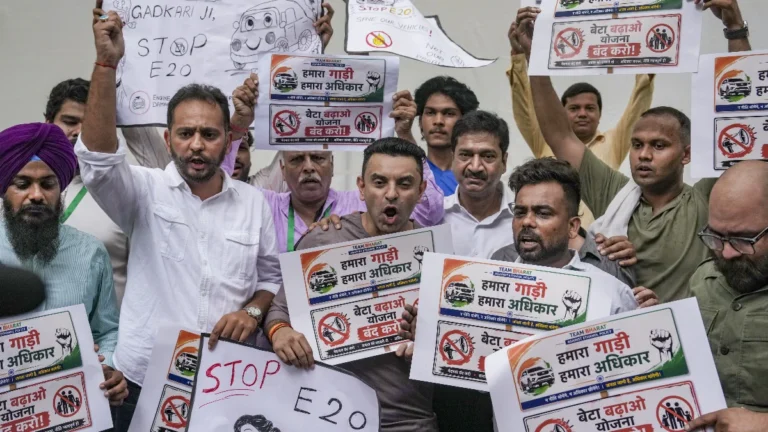
The debate moved from social media to the streets when political commentator and activist Tehseen Poonawalla organized what was described as India’s first major public protest against the E20 rollout, held at Delhi’s Jantar Mantar.
The protest was organized under the banner “Team Bharat Against the Ethanol Scam,” and Poonawalla was explicit that it wasn’t a political-party event. His framing: ordinary, middle-class vehicle owners who felt their money had gone into cars now behaving unpredictably.
He also announced a follow-up demonstration called a “Gaadi March,” and separately, the Delhi Taxi and Tourist Transporters and Tour Operators Association planned its own march to Parliament, citing fuel efficiency, maintenance costs, and engine performance concerns — particularly for older commercial vehicles that see far higher daily mileage than private cars.
E20 Janta Party: The New Protest Page Going Viral
If you’ve seen a new account gaining followers at an unusual speed, this is almost certainly what you’re thinking of.
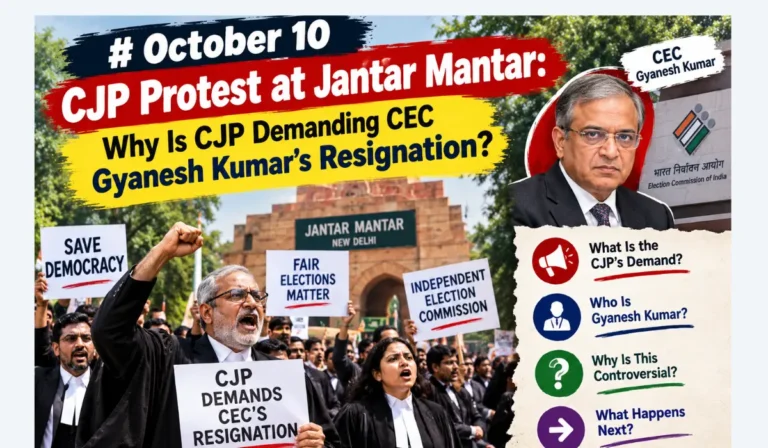
The E20 Janta Party (@E20Party) is a satirical, citizen-led social media movement that emerged shortly after the Cockroach Janta Party (CJP) — the youth movement behind the protests that led to Education Minister Dharmendra Pradhan’s resignation — wound down its own agitation.
Here’s what’s confirmed about it:
- The account’s founder remains unknown/anonymous.
- It gained roughly 25,000 followers within hours, crossing 48,000 followers by the next morning, with its Instagram page passing 100,000 followers over the same weekend.
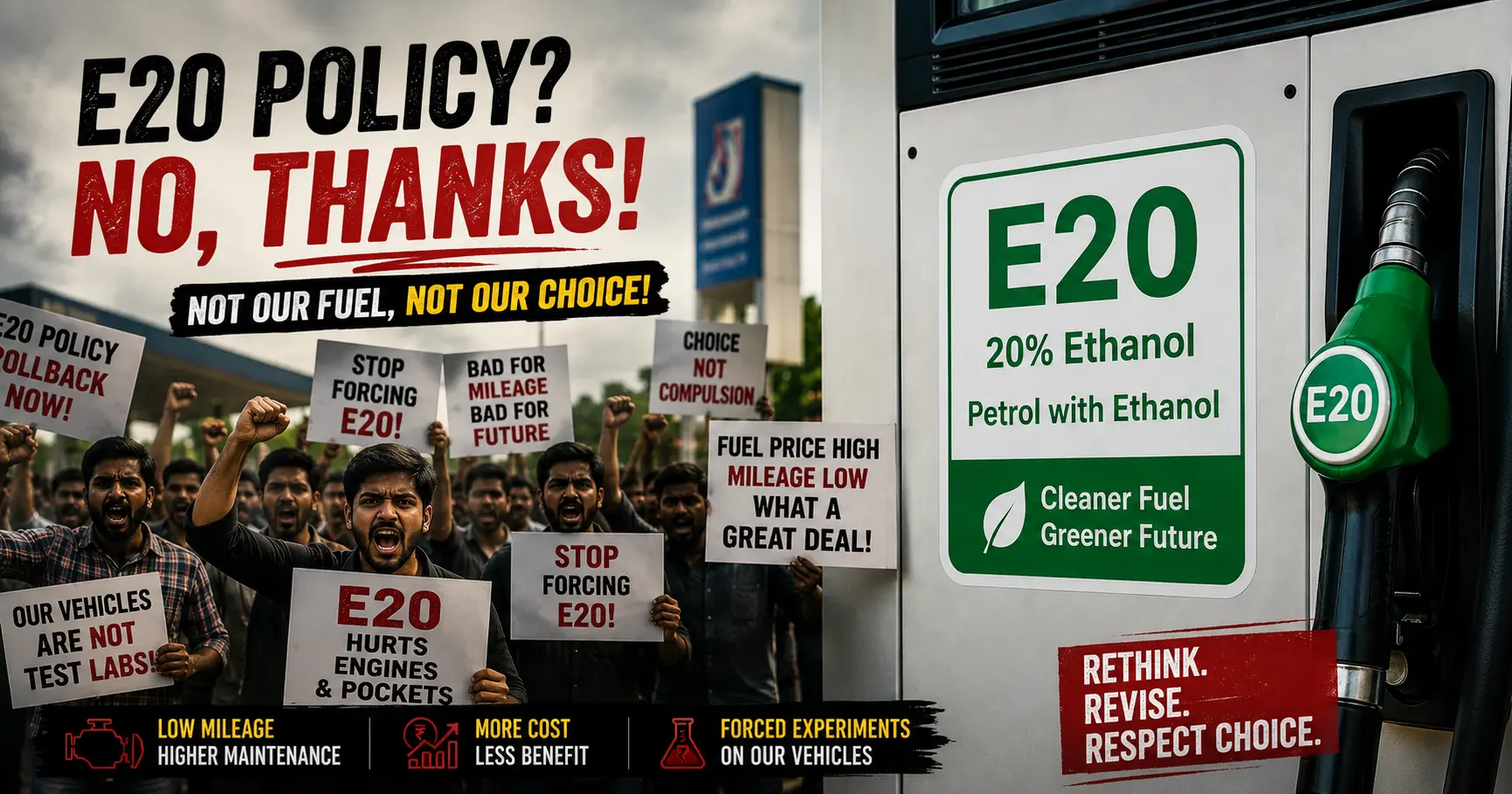
- Its central demand is simple and deliberately modest: it is not asking for a rollback of E20, a subsidy, or free fuel. It’s asking fuel stations to sell 100% petrol alongside E20, so consumers can choose.
- It borrows CJP’s exact playbook — memes, short slogans, and parody posts rather than long policy documents — and even directly referenced CJP founder Abhijeet Dipke’s original “what if we all came together?” post, adapting it to “what if all bike/car owners come together?”
- It received amplification from AAP leader Manish Sisodia’s repost, and public backing from Tehseen Poonawalla.
- One detail has drawn skepticism: the account has reportedly been traced to a location outside India, which has led some commentators to question the authenticity of its grassroots framing, even though its demands and messaging track closely with complaints raised independently by Indian vehicle owners and the Jantar Mantar protesters.
- The government’s response so far, via the Petroleum Ministry and PIB India, has been that offering separate fuel grades at every pump is logistically unfeasible, citing roughly ₹1 lakh crore already invested in scaling up ethanol production infrastructure.
Worth noting: a fast-growing anonymous account isn’t automatically proof of either a massive genuine grassroots movement or a coordinated inauthentic campaign — it can be evidence of real public frustration amplified by clever, low-cost messaging, regardless of who’s running the page. Readers should treat the account’s popularity as a signal of public sentiment, not as verified data about vehicle damage.
Gadkari vs Car Owners: Comparing the Two Sides
| Point of Debate | Government / Gadkari’s Position | Car Owners / Protesters’ Position |
|---|---|---|
| Mileage drop | 2–4%, based on controlled lab tests | Often far higher in real-world driving, per owner reports |
| Engine damage | No confirmed cases nationwide | Some owners report rubber/plastic wear and rough performance |
| Older vehicles (pre-2023) | Compatible if E10-rated, per government | More vulnerable, since not built with E20-spec materials |
| Cause of criticism | “Paid,” politically motivated campaign | Genuine consumer frustration, not political |
| Consumer choice | Can buy 100% petrol at a higher price | Should be available at the same pumps, same convenience |
| Complaint mechanism | Government says it invited complaints and received none | Activists say access to officials to present cases has been blocked |
What Does the Science Actually Say?
Stripping away the politics, here’s what’s actually been studied:
- Studies jointly conducted by Indian Oil Corporation (IOCL), the Indian Institute of Petroleum (IIP) Dehradun, SIAM, and ARAI found E20 does not require engine modification and meets BS-VI emission norms when tested.
- These same studies found no significant variation in performance or abnormal wear-and-tear, including in legacy (older) vehicles tested.
- The government has acknowledged that any long-term material degradation in fuel-system rubber components can typically be addressed through routine, inexpensive replacement during regular servicing — not a sign of catastrophic engine damage.
- Ethanol’s lower energy content is scientifically undisputed. It’s the scale of its real-world impact — lab test versus daily driving — where the two sides genuinely disagree.
The honest, balanced conclusion: the core science on E20 compatibility for BS-VI, E20-rated vehicles is fairly settled and not seriously disputed by independent testing bodies. Where the disagreement is real is in older, non-E20-rated vehicles, and in how much day-to-day, real-world mileage loss owners should reasonably expect versus what lab conditions predict.
Is Your Car Compatible With E20?
Here’s a simple way to check, based on official guidance:
- Check the manufacturing date. Vehicles sold after April 1, 2023 are generally built with E20-compliant materials.
- Look for the sticker. Manufacturers are required to display E20 compatibility on a visible sticker on the vehicle.
- Check your owner’s manual or manufacturer website. Most major brands, including Maruti Suzuki and Mercedes-Benz, have published compatibility statements.
- If your vehicle is older (pre-2023): it’s likely rated for E10, not E20. This is where caution and closer monitoring of mileage and engine behavior is most reasonable.
- When in doubt, ask your service centre directly — not social media — before assuming any performance issue is fuel-related, as the Sourav Joshi case shows.
What You Can Actually Do About It
- Track your mileage over 2-3 weeks, not two days, before drawing conclusions. Short-term fluctuations can come from traffic, AC use, driving style, or tyre pressure — not just fuel.
- Get a proper diagnostic at an authorized service centre if you notice a real, sustained drop — as Joshi’s case shows, the actual cause isn’t always the one that seems obvious.
- File a formal complaint with the relevant ministry if you genuinely believe E20 has damaged your vehicle; the government has stated it’s open to documented cases, even though activists dispute how accessible that process really is.
- Check your fuel station’s blend actually matches label claims — quality control at the pump level is a separate issue from the ethanol policy itself.
- If buying a new vehicle, choosing an E20-rated, BS-VI model removes most of the uncertainty going forward.
Myths vs Facts
| Myth | Fact |
|---|---|
| E20 petrol is destroying engines nationwide | No independently verified case of widespread engine failure has been documented; disputes remain over milder wear and mileage claims |
| Sourav Joshi’s video proved E20 damages Mercedes cars | Joshi retracted the claim after his service centre found an unrelated engine issue |
| The E20 Janta Party is a purely political operation | It presents itself as a non-political, citizen-led consumer campaign, though its anonymous origin has drawn scrutiny |
| You have no choice but to use E20 | 100% petrol remains available, though typically at a higher price |
| All cars are affected equally | Vehicles made after April 2023 are E20-rated by design; older vehicles carry more uncertainty |
Key Takeaways
- E20 petrol contains 20% ethanol and is now available nationwide as part of India’s ethanol-blending program.
- Nitin Gadkari maintains there’s no verified case of vehicle damage from E20 and calls the backlash a politically motivated campaign.
- SIAM and government-backed studies show a lab-tested 2–4% mileage drop, while acknowledging real-world conditions can push that number higher.
- Sourav Joshi’s viral claim about his Mercedes-Benz GLC turned out to be linked to an unrelated engine fault, not E20 — and he publicly apologized.
- Car companies including Mercedes-Benz, Maruti Suzuki, and Toyota have backed E20 compatibility for BS-VI vehicles.
- Activist Tehseen Poonawalla organized the first major street protest against E20 at Jantar Mantar; a new satirical movement, the E20 Janta Party, has since gone viral online with a simple demand: consumer choice at the pump.
- The clearest area of genuine, unresolved concern is around older, pre-2023, non-E20-rated vehicles.
Frequently Asked Questions
1. What is E20 petrol?
E20 is petrol blended with 20% ethanol, used nationwide in India as part of a government program to reduce oil imports and vehicle emissions.
2. Does E20 petrol damage car engines?
Government-backed studies from SIAM, ARAI, and IOCL report no significant engine damage or need for modification in E20-rated vehicles. Some owners report mileage drops and component wear, though this hasn’t been independently confirmed as a widespread pattern.
3. Why did Sourav Joshi apologize about his Mercedes claim?
After visiting a Mercedes-Benz service centre, technicians found his GLC’s mileage drop was caused by an unrelated engine issue, not E20 fuel. He publicly retracted his original claim.
4. What is the E20 Janta Party?
It’s an anonymous, satirical social media protest movement demanding that fuel stations sell pure petrol alongside E20, giving consumers a choice. It gained tens of thousands of followers within days of launching.
5. Can I still buy pure petrol in India?
Yes. According to Gadkari, 100% petrol remains available for those who prefer it, though typically at a higher price than E20.
6. Is my car compatible with E20 petrol?
Vehicles manufactured after April 1, 2023 are generally E20-compliant by design. Check for a compatibility sticker on your vehicle or consult your manufacturer’s official guidance.
7. What did the SIAM convention say about E20?
At the SIAM annual convention, Gadkari cited lab studies showing only a 2–4% mileage reduction and no widespread reports of engine failure, dismissing broader criticism as a politically motivated campaign.
8. Who organized the E20 protest at Jantar Mantar?
Activist and political commentator Tehseen Poonawalla organized the protest under the banner “Team Bharat Against the Ethanol Scam.”
9. Do car companies support E20 petrol?
Yes. Mercedes-Benz, Maruti Suzuki, Toyota, and Hero MotoCorp have all publicly backed E20 compatibility for their BS-VI vehicles.
10. What should I do if I think E20 has damaged my vehicle?
Get a proper diagnostic at an authorized service centre before assuming the cause, track mileage over several weeks rather than days, and file a formal complaint with the relevant ministry if the issue is confirmed to be fuel-related.
Conclusion
Strip away the noise, and the E20 debate comes down to one honest disagreement: how much does real-world driving diverge from lab conditions? The government’s data isn’t fabricated, and neither are the frustrations of vehicle owners who’ve genuinely noticed a difference at the pump.
What the Sourav Joshi episode really taught the country wasn’t that E20 is safe or unsafe — it’s that in the age of viral videos, the loudest claim isn’t always the most accurate one. The E20 Janta Party’s rapid rise shows people are paying attention and want answers. Whether that pressure leads to actual policy changes, like offering fuel choice at the pump, is the next chapter of this story — and one worth watching closely if you drive in India.