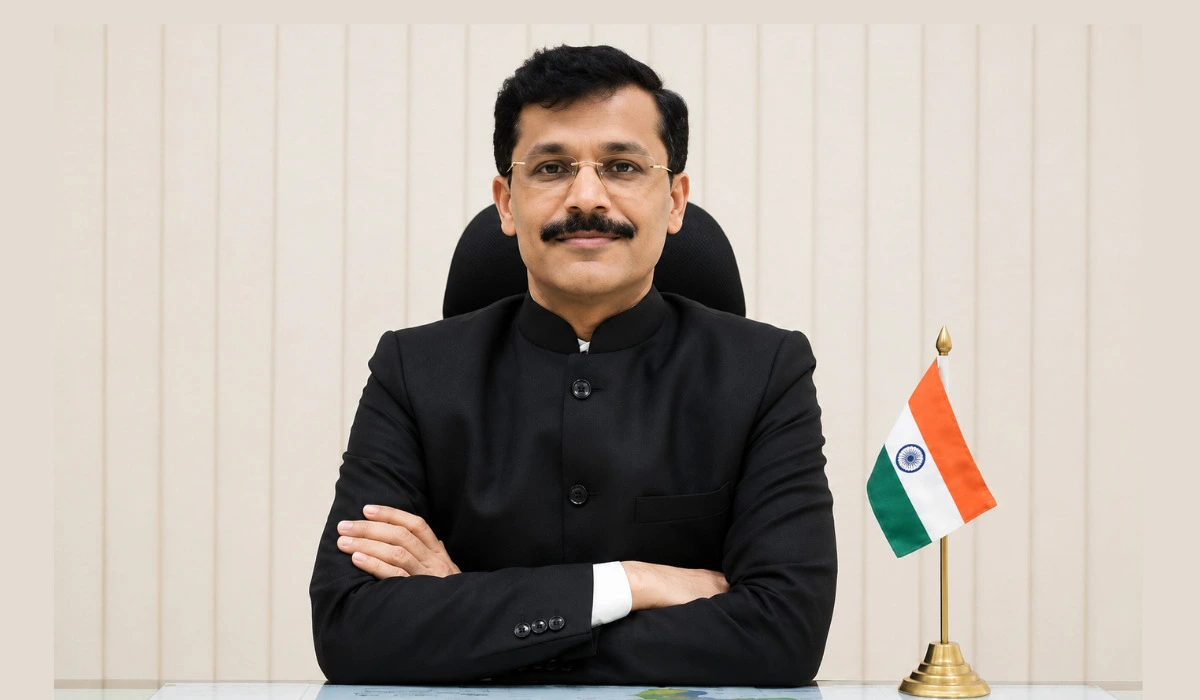
Tukaram Mundhe Biography: Early Life, UPSC Journey, Career, Transfers, Decisions & Latest Work
If you have followed Maharashtra’s news cycle for the last decade, you have probably seen his name trending at least once — usually right after he cancels a corrupt contract, shuts down an illegal business, or gets transferred for doing exactly that. Tukaram Mundhe is not your typical bureaucrat. He is the officer citizens ask the government not to transfer, and the officer some politicians can’t wait to move out.
This is the complete story — from a mud-brick house in a drought-hit village in Beed, to All India Rank 20 in the UPSC exam, to becoming the most-transferred IAS officer in Maharashtra, to his current, headline-grabbing role as Commissioner of the state’s Food and Drug Administration.
Quick Facts: Who Is Tukaram Mundhe?
| Detail | Information |
|---|---|
| Full Name | Tukaram Haribhau Mundhe |
| Date of Birth | 3 June 1975 |
| Birthplace | Tadsona village, Beed district, Maharashtra |
| Family Background | Farming (Vanjari) family |
| Education | B.A. (History), M.A. (Political Science) — Dr. Babasaheb Ambedkar Marathwada University, Aurangabad |
| UPSC Result | AIR 20, Civil Services Exam 2004 |
| Service | Indian Administrative Service (IAS), 2005 batch, Maharashtra cadre |
| Nicknames | “Singham IAS,” “Man on a Mission” |
| Known For | Strict, rule-based governance and one of the highest transfer counts in Maharashtra’s bureaucracy |
| Current Post (as of August 2026) | Commissioner, Food and Drug Administration (FDA), Maharashtra |
| Spouse | Archana Mundhe |
Now let’s go through his story in detail — the struggle, the decisions, and the reasons his name keeps coming back into the news.
Early Life: A Childhood Spent in the Fields, Not on the Playground
Tukaram Mundhe was born on 3 June 1975 in Tadsona, a small, drought-prone village in Maharashtra’s Beed district. His parents, Haribhau and Aasrabai Mundhe, were farmers, and the family lived in a modest mud-brick house.
There was no easy childhood here. From around the age of eight, Mundhe was already working the family farm — fencing fields, digging wells, sowing seeds, and helping sell produce at the local market. His village suffered frequent power cuts, which often meant waking up in the middle of the night just to water the crops whenever electricity returned. While other children played after school or during vacations, Mundhe went straight back to farm work.
This upbringing matters, because it explains a lot about the officer he later became. Someone who grew up watching how a broken system — poor irrigation, weak infrastructure, unreliable power — directly hurts ordinary families doesn’t need a textbook to understand why governance failures matter. He lived it.
His elder brother, Ashok Mundhe, was the first person from their village to graduate and enter civil service — a milestone that became a quiet source of inspiration for young Tukaram.
Key takeaway: Mundhe’s discipline and zero-tolerance approach to inefficiency didn’t come from a management course. It came from a childhood where hard work wasn’t optional.
Education Journey: From a Village School to a Master’s Degree
After completing his schooling, Mundhe moved to Aurangabad on his brother’s advice to pursue higher studies. He went on to complete:
- B.A. in History
- M.A. in Political Science
Both degrees were from Dr. Babasaheb Ambedkar Marathwada University, Aurangabad, and he graduated in 1996.
His path to the civil services wasn’t a straight line, though. Around 2000, his father suffered a paralytic attack, and the years between 2000 and 2004 became one of the toughest periods of his life. In interviews, Mundhe has described this stretch as difficult but formative — a period that forced him to build the decision-making ability that later defined his career.
The UPSC Journey: Failure, Persistence, and All India Rank 20
Here’s a detail that a lot of aspirants find genuinely encouraging: Tukaram Mundhe did not clear his first attempt.
He first tried the state-level MPSC (Maharashtra Public Service Commission) exam and failed three times before finally clearing it in 2001. That MPSC training became an important stepping stone — it gave him real exposure to how government machinery actually functions, from the inside.
He didn’t stop there. He went on to attempt the UPSC Civil Services Examination and secured All India Rank 20 in CSE 2004, earning him a place in the 2005 batch of the IAS, Maharashtra cadre.
State-level public service commissions like the MPSC are still where most civil service journeys in India actually begin — and they can be just as high-stakes and contested as the UPSC itself. If you want to see how volatile that process can get when things go wrong, our coverage of the JPSC/JSSC recruitment protests in Jharkhand shows exactly why state PSC exams matter so much to aspirants.
What Aspirants Can Learn From His UPSC Story
- Failure isn’t disqualifying. Three MPSC failures didn’t stop him from eventually landing a top-20 All India Rank.
- State-level exams build real administrative sense. His MPSC experience gave him practical exposure that pure bookish preparation can’t replicate.
- Personal crises don’t have to derail your goal. He prepared through one of the hardest phases of his life — his father’s illness — and still delivered a top result.
IAS Career Timeline: A Career Defined by Constant Movement
Mundhe joined the IAS in the 2005 batch and began his training with a posting as Chief Officer of Barshi Municipality in Solapur district. Even during training, he wasn’t playing it safe — he moved against more than 15,000 illegal encroachments and shut down unauthorised industrial units.
His official career began on 22 August 2005 as Supernumerary Assistant Collector in Solapur. One of his earliest actions: shutting down an illegal bar owned by a locally powerful politician. It set the tone for everything that followed.
Here is a snapshot of his major postings over the years:
| Posting | Role | Notable Action |
|---|---|---|
| Solapur | Assistant Collector / District Collector | Uncovered a property tax scam worth roughly ₹900 crore; action against corrupt officials |
| Navi Mumbai (2016) | Municipal Commissioner | Suspended a senior official over irregularities; pushed recovery of long-pending MIDC tax arrears; prioritised e-governance |
| Nashik (2017–2018) | Municipal Commissioner | Surveyed illegal constructions (found over 2 lakh irregular structures); revised property tax rates, which triggered a major public controversy |
| Pune (2017–2018) | Chairman & Managing Director, PMPML | Focused on financial discipline and operational efficiency at the loss-making transport utility |
| Nagpur (2020) | Municipal Commissioner | Restructured the tax department to rationalise property tax collection |
| Various state departments | Director, National Health Mission; Secretary, Revenue & Disaster Management | Administrative and policy-level reforms |
| Maharashtra FDA (May 2026–present) | Commissioner | Statewide crackdown on food adulteration and unsafe products |
Across his career, Mundhe has held more than 25 postings, averaging well under the standard three-year tenure norm for IAS officers — some reports count 23, others 25 or 27, depending on how short-term or training-related postings are counted. What’s consistent across every source: this is one of the highest transfer counts of any serving IAS officer in India.
The Nashik Property Tax Decision: His Most Controversial Call
If there’s one decision that defines the “Mundhe pattern” — bold action, public backlash, political pressure, transfer — it’s the Nashik property tax hike.
On 31 March 2018, as Nashik’s Municipal Commissioner, Mundhe issued Order No. 522, sharply increasing the taxable value of properties across the city — reports suggest the hike ranged from 30% to as high as fivefold for certain categories, including agricultural land and open plots. The backlash was immediate. Farmers protested. Political parties across party lines united against the decision, and the Nashik Municipal Corporation passed resolutions to cancel it — twice.
Mundhe stood his ground, arguing the revision corrected years of under-assessment. But the political cost was real: a no-confidence motion was moved against him, and in February 2018, he was transferred out — an exit local media described at the time as a “bitter farewell.”
The irony? Years later, in 2024, the state government was still trying to formally resolve the very tax order Mundhe had issued back in 2018 — proof that the underlying assessment issue he flagged didn’t simply disappear once he left.
Why Does Tukaram Mundhe Get Transferred So Often?
This is the question almost everyone asks, and the answer isn’t complicated once you see the pattern across his postings:
- He enforces rules without exceptions — including against locally powerful politicians, contractors, and senior officials.
- He audits revenue leakages — property tax, industrial dues, licensing — which upsets people benefiting from the status quo.
- He refuses political interference in day-to-day administrative decisions.
- The backlash follows a familiar sequence: reform → public support → political discomfort → no-confidence motion or pressure → transfer.
As Mundhe himself once put it to a group of students, with characteristic dry humour, he’s had “the fortune of working for people across Maharashtra, Nagpur to Mumbai” — precisely because he keeps getting transferred.
Frequent transfers are usually read as an officer being sidelined. In Mundhe’s case, most administrative observers read it the opposite way: each posting produced a visible, measurable change before political friction triggered the next move.
Leadership Style: What Makes Him “Singham IAS”
A few consistent traits show up across every posting in his career:
- Day-one audits. He typically starts by personally reviewing pending files, tax collection data, and department performance — before settling into his own office.
- Zero tolerance for status-quo inefficiency. Officials who’ve held the same post for years without accountability are usually the first to be questioned.
- Public-facing communication. He regularly explains his decisions directly to citizens and media rather than only to political leadership.
- Consistency over popularity. He has repeatedly said he’d rather be transferred than compromise on enforcement.
This combination — decisive, transparent, and unyielding — is exactly why the public gave him nicknames like “Singham IAS” (after the fictional no-nonsense police officer) and “Man on a Mission.”
Personal Life
Tukaram Mundhe is married to Archana Mundhe. Public biographical sources also list two children, Agastya and Ashana, though Mundhe has generally kept his family life away from the public eye, choosing to let his administrative record speak for itself.
His life story has also been documented in a full-length biography, “Tukaram” (तुकाराम), written by journalist and Marathi-language scholar Shafi Pathan and published in July 2026.
Latest Work: Commissioner, Maharashtra FDA (2026)
As of August 2026, Tukaram Mundhe holds his most talked-about role yet: Commissioner of the Food and Drug Administration (FDA), Maharashtra, a post he took charge of on 15 May 2026 — reportedly his 25th transfer in a 21-year career.
Under his leadership, the FDA has launched an aggressive statewide enforcement drive branded “Safe Food, Safe Medicine, Safe Maharashtra.” Highlights of this crackdown include:
- Over a thousand inspections ordered across food and drug establishments in a short span.
- Licence cancellations for non-compliant outlets, including a well-known quick-commerce store.
- Show-cause notices to celebrities, including Shah Rukh Khan, Ajay Devgn, and Tiger Shroff, over their endorsement of a pan masala–linked brand (Vimal Elaichi), for allegedly promoting a restricted product category.
- A clear public message that no one — however influential — is exempt from food safety law.
This latest chapter has made Mundhe one of the most searched IAS officers in India again, with his signature approach — audit first, enforce without exception, explain publicly — playing out at a much bigger, more visible scale than ever before.
Key Lessons From Tukaram Mundhe’s Career
Whether you’re a UPSC aspirant, a public administration student, or simply someone who follows governance stories, here’s what stands out:
- Integrity has a cost, and he’s paid it repeatedly — 25+ transfers in 21 years is not a small price.
- Short tenures can still produce real, measurable reform — property tax corrections, encroachment removals, tax scam exposures.
- Public support can’t always prevent political transfers, but it can shape how an officer’s legacy is remembered.
- Rule-based governance often creates short-term friction and long-term credibility — several of his controversial calls (like the Nashik tax order) were later revisited by governments that couldn’t simply dismiss the underlying data.
Frequently Asked Questions (FAQs)
Q1. Who is Tukaram Mundhe? Tukaram Mundhe is a 2005-batch IAS officer from the Maharashtra cadre, known for strict, rule-based administration and for holding one of the highest numbers of transfers among serving Indian bureaucrats.
Q2. What is Tukaram Mundhe’s UPSC rank? He secured All India Rank 20 in the UPSC Civil Services Examination of 2004, after earlier failing the state-level MPSC exam three times before clearing it in 2001.
Q3. Why is Tukaram Mundhe transferred so frequently? His transfers typically follow a pattern: he enforces rules strictly, audits revenue and irregularities, and refuses political interference — actions that generate strong public support but also political friction, which usually results in a transfer.
Q4. What is Tukaram Mundhe’s current post? As of August 2026, he serves as Commissioner of Maharashtra’s Food and Drug Administration (FDA), a position he took up on 15 May 2026.
Q5. Why is Tukaram Mundhe called “Singham IAS”? The nickname comes from his fearless, no-compromise enforcement style, drawing comparisons to the fictional police officer character known for standing up to corruption regardless of political pressure.
Q6. Did Tukaram Mundhe clear UPSC on his first attempt? No. He first cleared the state-level MPSC exam in 2001, on his fourth attempt, before going on to secure AIR 20 in the UPSC CSE 2004.
Q7. What is Tukaram Mundhe’s educational qualification? He holds a B.A. in History and an M.A. in Political Science, both from Dr. Babasaheb Ambedkar Marathwada University, Aurangabad.
Final Thoughts
Tukaram Mundhe’s story isn’t really about being “the toughest officer in Maharashtra.” It’s about what happens when someone from a genuinely difficult background gets a position of authority and simply refuses to treat the rulebook as optional. He’s been rewarded with public admiration and punished with repeated transfers — often for the exact same decision.
Two decades in, that pattern hasn’t changed. And going by his current run at the FDA, it doesn’t look like it’s slowing down anytime soon.
Interested in how the people running India’s institutions actually shape policy on the ground? Take a look at our full list of India’s Education Ministers from 1947 to 2026 for another side of how public administration gets done at the top.