Water Cannons, Tear Gas and a Hunger Strike: What’s Really Happening at Jharkhand’s Student Protest
A man on a nine-day hunger strike, too weak to walk, being carried through a protest march in an ambulance. Thousands of students breaking through eight layers of police barricades. Water cannons. Tear gas shells. A state on the edge of a bandh.
This isn’t a scene from a decade-old headline. It happened this week, in Ranchi, and it’s still unfolding.
For 18 days now, job aspirants across Jharkhand have been camped outside government offices and marching toward the state Assembly, demanding answers about recruitment exams they say were rigged. On Monday, August 10, that agitation reached a breaking point — and by Tuesday, it had triggered a statewide shutdown. Here’s the full, honest picture of what’s happening, why, and what it might mean going forward.
Quick Answer
Students and job aspirants in Jharkhand have been protesting since July 25, 2026, demanding transparency in recruitment exams run by the Jharkhand Public Service Commission (JPSC) and Jharkhand Staff Selection Commission (JSSC), alleging paper leaks and manipulated answer sheets. On August 10, thousands marched toward the Jharkhand Assembly in a “Vidhan Sabha Gherao,” breaking through eight layers of barricades. Police responded with water cannons, tear gas, and a lathi-charge, injuring several protesters and four policemen. JLKM leader Devendra Nath Mahto, on a nine-day hunger strike, joined the march by ambulance and was hospitalized after his health deteriorated. The BJP called a statewide bandh for August 11, while the ruling JMM government maintains it has already met most of the protesters’ demands. As of this writing, the standoff continues, with no resolution yet.
Table of Contents
- Why Are Jharkhand’s Students Protesting?
- Timeline: 18 Days That Led to This
- Monday, August 10: The Day It Escalated
- The Devendra Nath Mahto Hunger Strike
- What Police and Protesters Each Say Happened
- The Arrest That Changes the Narrative
- The Political Fallout: Bandh, Detentions and Accusations
- Where Talks Between the Government and Students Stand
- Why This Isn’t Jharkhand’s First Recruitment Exam Protest
- What Happens Next
- Key Takeaways
- Frequently Asked Questions
Why Are Jharkhand’s Students Protesting?
Strip away the politics, and the core grievance is simple: thousands of young people in Jharkhand spent months, sometimes years, preparing for government job exams — and they believe the process was compromised before they ever sat down to write.
The protest centers on two recruitment bodies: the Jharkhand Public Service Commission (JPSC), which conducts civil services exams, and the Jharkhand Staff Selection Commission (JSSC), which handles broader government staff recruitment. Protesters allege irregularities including paper leaks and manipulation of OMR answer sheets in multiple exams, most notably the JSSC-CGL (Combined Graduate Level) exam and the JPSC’s 14th Combined Civil Services Preliminary Examination.
Their core demands, organized under the banner of the JPSC-JSSC Reforms Manch, are:
- Cancellation of the exams they believe were compromised
- Structural reforms in how both commissions operate
- An independent investigation — specifically a CBI probe or a credible external panel, rather than an internal inquiry
This isn’t a new complaint appearing out of nowhere. Similar allegations around JSSC exams have surfaced repeatedly over the past two years, and this round of protests has simply refused to fade the way earlier ones did.
Timeline: 18 Days That Led to This
| Date | What Happened |
|---|---|
| July 25, 2026 | Students and job aspirants begin agitating under the JPSC-JSSC Reforms Manch, demanding exam transparency and reforms |
| Ongoing through early August | Sustained protests continue; demonstrators are reportedly denied permission to set up tents at the protest site even during heavy rainfall |
| Sunday, August 9 | Sixth round of talks between the state government and protesters fails to produce a breakthrough; both sides accuse each other of not negotiating seriously |
| Monday, August 10 (Day 17) | Thousands march toward the Assembly in a planned “Vidhan Sabha Gherao”; barricades are breached; police use water cannons, tear gas, and lathi-charge |
| Monday, August 10 | Jharkhand CID arrests former JPSC chairman L. Khiangte over alleged irregularities in the 14th Combined Civil Services Preliminary Examination |
| Tuesday, August 11 (Day 18) | BJP observes a statewide bandh from 8 AM to midnight; ABVP organizes a fresh march to the Assembly |
Monday, August 10: The Day It Escalated
The march began around 10:30 AM from outside the old Assembly building, with organizers estimating volunteer numbers in the hundreds specifically deployed to keep the protest peaceful — the JPSC-JSSC Reforms Manch said it had around 500 volunteers on the ground to prevent what it called “anti-social elements and troublemakers” from infiltrating the demonstration.
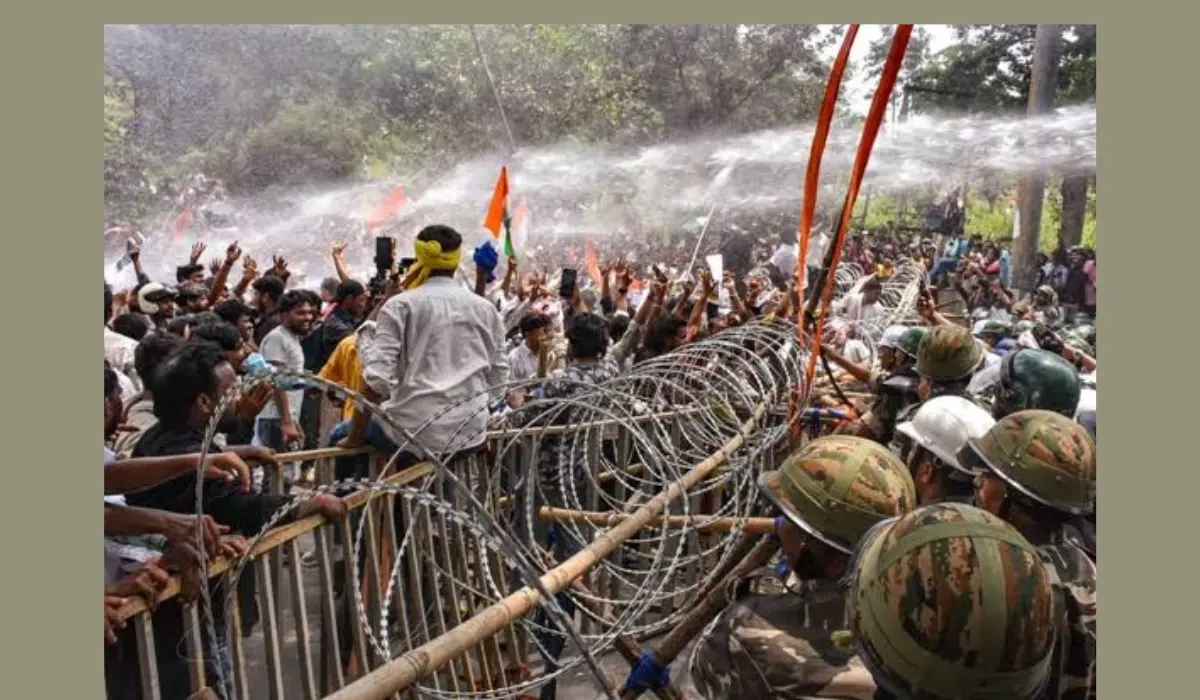
It didn’t stay peaceful for long. Authorities had prepared for exactly this scenario: eight layers of barricades, some reinforced with barbed wire, heavy police deployment, magistrates on standby, and drones providing aerial surveillance. The security operation was led by ADG Manoj Kaushik and Ranchi SSP Rakesh Ranjan.
Protesters pushed through the main route first. When police responded with water cannons and tear gas there, the crowd didn’t disperse — it adapted. Demonstrators rerouted through forests, footpaths, and farm fields, eventually converging near the new Assembly building and the MLAs’ residential complex from multiple directions at once.
By afternoon, various groups of protesters had breached the barricades entirely and reached Gate No. 1 of the Assembly, where they staged a sit-in and refused to leave. Police responded with a fresh, heavier round of lathi-charge to clear the area.
The human cost, by both sides’ own accounts: protesters allege that several demonstrators, including women, were injured during the police action. Ranchi City SP Paras Rana confirmed four policemen were injured, attributing it to stone-pelting by the crowd. Both claims have circulated without full independent verification of exact injury counts, which is worth noting honestly rather than picking a number to state as fact.
The Devendra Nath Mahto Hunger Strike
If one image captures the emotional weight of this protest, it’s this one: a protest leader, weakened by nine days without food, arriving at the march site in an ambulance because he could no longer walk on his own.
Devendra Nath Mahto, a leader affiliated with the JLKM (Jharkhand Loktantrik Krantikari Morcha) and previously a Jharkhand State Students’ Union figure in earlier recruitment protests, had been on a hunger strike for nine days by the time of Monday’s march. Reports indicate he had lost 10.5 kilograms over the course of the strike.
Despite his condition, Mahto joined the demonstration from the ambulance and addressed the crowd from a stretcher. During the march, his health deteriorated sharply — his blood sugar level reportedly dropped drastically, and he was rushed to Ranchi Sadar Hospital, where doctors initially described his condition as critical. His aide has alleged he was also injured during the police lathi-charge.
This is the detail that turned a policy dispute into a story with real, immediate human stakes — and it’s a large part of why the protest’s images spread so quickly this week.
What Police and Protesters Each Say Happened
Rather than picking a side, here’s a fair, side-by-side account of the competing claims:
| Claim | Police/Administration Position | Protesters’ Position |
|---|---|---|
| Who escalated first | Protesters broke through barricades and threw stones, slippers, and bottles | Peaceful demonstrators were met with disproportionate force |
| Injuries | Four policemen injured due to stone-pelting | Several protesters, including women, injured during lathi-charge |
| Purpose of the barricades | Standard security protocol for a restricted zone around the Assembly during the monsoon session | An attempt to physically block a legitimate, long-running demand for dialogue |
| Overall framing | A law-and-order response to a breach of a secured area | Excessive force against unarmed students exercising their right to protest |
Both accounts likely contain real elements of truth. Large protests that breach multiple layers of security barricades rarely stay entirely peaceful on either side, and Indian protest law does give police authority to disperse crowds that breach restricted zones — but the scale of the response, and whether it was proportionate, is exactly the question now being fought out in the political arena.
The Arrest That Changes the Narrative
One development from Monday adds real weight to the protesters’ underlying claims, separate from the clash itself: the Jharkhand CID arrested former JPSC chairman L. Khiangte in connection with alleged irregularities in the commission’s 14th Combined Civil Services Preliminary Examination.
Additional Director General (CID) Manoj Kaushik confirmed the arrest was tied specifically to recruitment exam irregularities. This matters because it’s an independent, official action — not a protester’s allegation — that lends institutional credibility to the idea that something did go wrong in at least one of the exams at the center of this protest.
It doesn’t resolve the broader dispute, but it does complicate any framing of this protest as purely manufactured outrage.
The Political Fallout: Bandh, Detentions and Accusations
By Tuesday, the story had moved decisively from the streets into the political arena.
- BJP called a statewide bandh from 8 AM to midnight on August 11, specifically in protest of the police action on Monday. State BJP president Aditya Sahu said the shutdown would bring the state “to a standstill,” with only essential services and Kanwariya pilgrims exempted from disruption.
- Sahu directly accused the Hemant Soren-led JMM government of using excessive force, claiming hundreds of students were injured and describing the government as treating students “like criminals.”
- Leader of Opposition Babulal Marandi and several BJP MLAs were themselves detained while protesting outside Chief Minister Hemant Soren’s residence, demanding accountability.
- In a notable twist, Rahul Gandhi, Leader of the Opposition in the Lok Sabha, condemned the police action — notable because the Congress party is actually a coalition ally of the JMM government in Jharkhand, meaning this criticism came from within the ruling alliance’s own broader political family, not purely from the opposition.
- ABVP (Akhil Bharatiya Vidyarthi Parishad) condemned the lathi-charge, water cannons, and tear gas, and announced its own fresh march to the Assembly for August 11.
- Chief Minister Hemant Soren, for his part, cautioned students against being pulled into what he characterized as the political opposition’s narrative — signaling the government’s position that the protest is being amplified for political gain rather than treated purely as a student-led movement.
Where Talks Between the Government and Students Stand
Here’s a detail that’s easy to miss in the noise: this didn’t happen because nobody tried to talk.
A sixth round of formal talks between the state government and protesters, under the JPSC-JSSC Manch, took place on Sunday, August 9 — the day before the violent march. It failed to produce a resolution.
The two sides don’t even agree on how close they are to a resolution. The government’s negotiating panel says it’s “unfortunate” the students didn’t lift the agitation, insisting the administration had already conceded to 98% of their demands. The protesters flatly reject that figure, insisting it doesn’t reflect reality and that their core demands — particularly cancellation of the disputed exams and an independent CBI probe — remain unmet.
That 2-percentage-point gap, as the government frames it, is clearly not a small technicality to the people still marching in the streets — which tells you the disputed 2% likely includes exactly the demands protesters consider non-negotiable.
Also read article Punjab Protest 2026
Why This Isn’t Jharkhand’s First Recruitment Exam Protest
If this story feels familiar, that’s because it is. Jharkhand has seen a recurring pattern of recruitment-related student unrest over the past several years:
- In December 2024, police lathi-charged candidates protesting alleged malpractices during JSSC-CGL document verification, and detained the same student leader, Devendra Nath Mahto, at the time under the Jharkhand State Students’ Union banner.
- In September 2024, thousands protested outside the JSSC office alleging malpractice in the JGGLCCE exam.
- In March 2023, police used batons and tear gas on youths attempting to gherao the Assembly over a new recruitment policy.
- Multiple bandhs since 2023 have centered on related grievances, including local reservation quotas in government jobs.
The throughline across all of these: a pattern of exam-related trust issues between Jharkhand’s youth and its recruitment institutions that hasn’t been durably resolved despite years of protest, negotiation, and, at times, partial concessions.
What Happens Next
As of this writing, several threads remain genuinely unresolved:
- Devendra Nath Mahto’s health status following his hospitalization
- Whether today’s ABVP march and BJP bandh lead to further clashes or pass without major incident
- Whether the L. Khiangte arrest leads to a broader CBI investigation, which is the protesters’ central demand
- Whether a seventh round of talks gets scheduled, and whether the government revises its “98% conceded” framing in response to continued pressure
This is very much a live, developing situation rather than a resolved news story — worth checking for updates rather than treating this account as the final word.
Key Takeaways
- Jharkhand’s JPSC-JSSC protest began on July 25, 2026, and has now stretched past 18 days.
- Core demands: cancellation of exams believed to be compromised (notably JSSC-CGL and JPSC’s 14th Combined Civil Services Prelims), commission reforms, and an independent CBI probe.
- On August 10, thousands of protesters breached eight layers of barricades during a Vidhan Sabha Gherao march, prompting police to use water cannons, tear gas, and lathi-charge.
- JLKM leader Devendra Nath Mahto, nine days into a hunger strike, was hospitalized after joining the march and suffering a health crisis.
- The Jharkhand CID’s arrest of former JPSC chairman L. Khiangte lends independent weight to the protesters’ underlying allegations.
- The BJP called a statewide bandh for August 11; even Congress’s Rahul Gandhi, whose party is a JMM coalition ally, condemned the police action.
- Six rounds of formal talks have failed to resolve the standoff, with the government and protesters disputing how close they actually are to an agreement.
Frequently Asked Questions
1. Why are students protesting in Jharkhand?
They’re protesting alleged irregularities — including paper leaks and OMR sheet manipulation — in recruitment exams run by the JPSC and JSSC, demanding exam cancellations, commission reforms, and an independent CBI investigation.2. What happened on August 10 in Ranchi?
Thousands of protesters marched toward the Jharkhand Assembly, breaching eight layers of barricades. Police responded with water cannons, tear gas, and a lathi-charge, injuring several protesters and four policemen.3. Who is Devendra Nath Mahto?
He’s a JLKM leader who was on a nine-day hunger strike, having lost 10.5 kilograms, when he joined the August 10 march by ambulance. He was later hospitalized after his health deteriorated.4. What is the JPSC-JSSC Reforms Manch?
It’s the organizing body leading the protest, representing job aspirants demanding reforms and accountability from Jharkhand’s two main recruitment commissions.5. Why did the BJP call a statewide bandh?
The BJP called the bandh for August 11 in protest of what it called excessive police force used against student demonstrators during the August 10 march.6. Has anyone been arrested in connection with the alleged exam irregularities?
Yes. The Jharkhand CID arrested former JPSC chairman L. Khiangte over alleged irregularities in the 14th Combined Civil Services Preliminary Examination.7. Has the government offered to resolve the protesters’ demands?
The government says it has conceded to 98% of the protesters’ demands following six rounds of talks. Protesters dispute this figure and say their core demands remain unmet.8. Is this Jharkhand’s first protest over recruitment exams?
No. Similar protests, including lathi-charges and detentions, occurred in 2023 and 2024 over related recruitment and exam grievances.9. What is a “Vidhan Sabha Gherao”?
It refers to a protest tactic where demonstrators march to encircle or surround the state Legislative Assembly building to pressure lawmakers directly.10. Is the protest continuing?
As of this writing, yes — the situation remains active, with a bandh and fresh march both planned for August 11, and no confirmed resolution to the underlying dispute.
Conclusion
Underneath the water cannons and the political point-scoring is a much simpler story: a large group of young people who studied hard for a shot at a government job, and now don’t trust the system that was supposed to give them a fair one. That distrust didn’t appear this week — it’s been building for years, through repeated protests that never quite got resolved.
What makes this moment different is the scale of the confrontation and the human image at its center — a hunger-striking leader arriving on a stretcher to a protest that ended in tear gas. Whether that’s enough to finally force a real resolution, or just becomes one more entry in Jharkhand’s long history of recruitment exam unrest, depends entirely on what happens in the days right after this one.