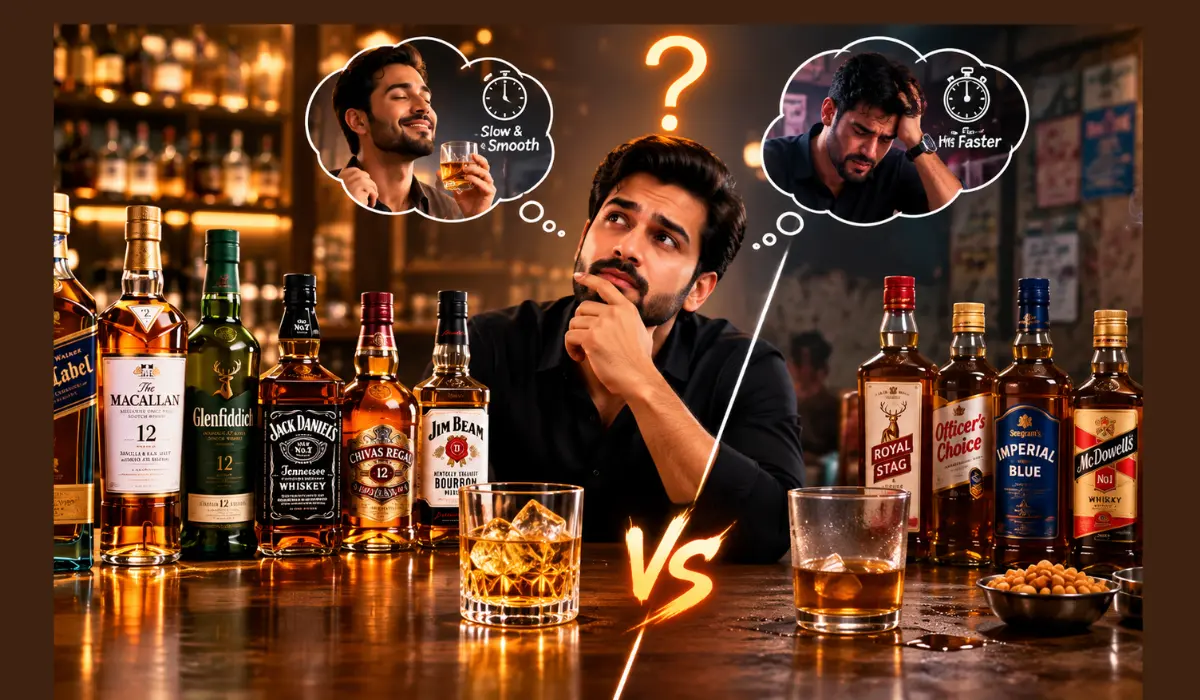
Branded Whiskey vs Local Whiskey: Why Do They Feel So Different?
Pour a branded Scotch and a local “desi” whiskey side by side, and you don’t need a trained palate to notice something is off. One glides down smooth, opens up with fruit and oak, and lingers pleasantly. The other hits sharp, burns a little too much, and leaves a sweet, almost syrupy aftertaste.
Most people assume this is just about price or “quality control.” It isn’t. The real answer sits much deeper — in what the whiskey is actually made from, how it’s distilled, and how long it’s allowed to mature before it reaches your glass.
Here’s the short version, followed by everything that goes into it.
Quick Answer
Branded whiskey (like Scotch or Indian single malts) is made from 100% malted grain, distilled in pot stills, and aged in oak barrels for years before bottling. Most local Indian whiskies are built on molasses-based spirit — a sugarcane by-product closer in composition to rum — blended with flavourings, colouring, and sometimes a small amount of real grain whisky, with no legal minimum ageing requirement. That single difference in raw material and process is why the taste, smell, and hangover experience feel worlds apart.
What Do We Actually Mean by “Branded” and “Local” Whiskey?
Before comparing them, it helps to define the two categories clearly — because “whiskey” means different things depending on where it’s made.
Branded whiskey, in the international sense, refers to whisky made under strict legal definitions: it must come from cereal grain (barley, corn, rye, or wheat), be distilled to a specific strength, and matured in wooden casks for a minimum period — three years for Scotch, for example. This includes global names like Johnnie Walker and Chivas Regal, and increasingly, Indian single malts such as Amrut, Paul John, Rampur, and Indri, which follow the same grain-to-cask process.
Local whiskey, in the Indian market, usually refers to what the industry calls IMFL — Indian-Made Foreign Liquor. This is the whiskey sold in the vast majority of Indian liquor shops: affordable, widely available, and built on a completely different base ingredient.
Key takeaway
- Branded whiskey = grain-based, aged, regulated by international whisky law
- Local IMFL whiskey = molasses-based neutral spirit, blended with flavour and colour, no ageing requirement under Indian food safety standards
The Core Difference: What’s Actually in the Bottle
This is the single biggest reason the two feel so different.
Most mass-market Indian whiskies are distilled not from grain, but from molasses — a thick by-product left over from sugar refining. India produces enormous quantities of sugar, so molasses is cheap and abundant. Distillers ferment and distil it into Extra Neutral Alcohol (ENA), then blend in flavouring agents, caramel colouring, and sometimes a small percentage of real grain or malt whisky (often around 10–12%) to build a whisky-like character.
Outside India, a spirit made this way wouldn’t legally be called whisky at all — in the US, UK, and EU, the term is reserved for spirits distilled from cereal grain. That’s precisely why IMFL brands can’t be exported and sold as “whisky” in those markets.
Branded whisky, by contrast, starts and ends with grain. Scotch single malt uses 100% malted barley. Grain whisky uses wheat or maize. Indian single malts follow the same rule, typically using six-row barley grown in the north of the country. There’s no molasses, no shortcut, and no neutral filler spirit standing in for flavour.
Why the Distillation Process Changes Everything
Even when grain is involved, how it’s distilled matters just as much as what’s distilled.
Molasses-based ENA is distilled repeatedly until it becomes almost entirely neutral — odourless and flavourless by design. That neutrality is the whole point: it’s a blank canvas that manufacturers then build flavour onto using additives.
Grain whisky destined for a premium blend or single malt is distilled differently — often in copper pot stills, and deliberately not pushed to full neutrality. Copper reacts with sulphur compounds during distillation, softening the spirit and letting genuine grain character survive into the cask. That surviving character is what later interacts with oak to create the layered taste branded whiskies are known for.
In short: one process is designed to erase flavour so it can be added back artificially. The other is designed to preserve and develop flavour naturally.
Ageing: The Ingredient Local Whiskey Usually Skips
Ageing is where the real transformation happens — and it’s the most commonly missed factor by everyday drinkers.
When spirit rests in an oak barrel for years, it slowly extracts colour, vanilla and caramel notes, and tannins from the wood, while harsh compounds mellow out. This is why a well-aged Scotch or Indian single malt tastes rounded rather than sharp.
Under Indian food safety standards, whisky can legally be sold with no minimum ageing period at all. Many IMFL brands rely on flavouring, caramel colour, and blending techniques to simulate an aged character quickly and cheaply, rather than actually earning it through years in wood. Some IMFL labels do include genuinely aged stock, but it’s the exception, not the rule.
Interestingly, India’s hot climate actually accelerates maturation for the whiskies that are properly aged — a phenomenon distillers call the “angel’s share.” Barrels lose alcohol to evaporation much faster in Indian warehouses than in Scotland’s cool cellars, which is why Indian single malts can develop deep, oaky character in far less time than Scotch — but it also makes proper ageing more expensive, since more spirit is lost along the way.
Taste, Smell, and the “Morning After” Difference
This is where all the above factors show up in the glass.
- Branded/aged whisky: layered aroma (fruit, vanilla, spice, oak), smoother texture, a lingering finish, less burn per sip
- Local IMFL whisky: simpler, sweeter, sometimes syrupy taste; flavour that sits more on the surface than in the background; noticeably sharper burn
- Next-day feeling: heavily flavoured, minimally aged spirits tend to carry more congeners and additives, which many drinkers associate with harsher hangovers — though hydration, quantity, and individual tolerance play a big role too
None of this means local whiskey is “bad.” It means it’s a different product built for a different price point and palate — India’s taste for sweeter spirits shaped this category deliberately, not accidentally.
Branded vs Local Whiskey: Quick Comparison
| Factor | Branded Whiskey (Scotch / Indian Single Malt) | Local Whiskey (IMFL) |
|---|---|---|
| Base ingredient | 100% malted grain (barley, wheat, maize) | Molasses-based neutral spirit + small % grain |
| Distillation | Pot stills, flavour deliberately retained | Column stills, distilled to neutral |
| Minimum ageing | 3 years (legal requirement for Scotch) | No legal minimum in India |
| Flavour source | Grain + oak cask maturation | Added flavouring, caramel colouring |
| Global “whisky” status | Legally recognised worldwide | Not legally whisky in US/UK/EU |
| Typical price point | Premium to super-premium | Mass-market, budget-friendly |
| Taste profile | Layered, smoother, complex finish | Sweet, simpler, sharper burn |
Common Mistakes People Make When Comparing the Two
- Assuming all Indian whisky is fake whisky. Indian single malts like Amrut and Rampur are 100% grain-based and compete with — and beat — international Scotch at global awards.
- Judging quality purely by price. Price reflects raw material and ageing cost, but personal taste still matters — some drinkers genuinely prefer the sweeter IMFL profile.
- Thinking a dark colour means well-aged. Caramel colouring can darken a whisky that hasn’t touched a cask for long at all.
- Believing “smooth” always means “better.” Smoothness comes from ageing and grain quality, but it’s a preference indicator, not a moral one.
How to Choose Between Them (Practical Checklist)
- Check the label for “single malt” or “grain whisky” — this usually signals 100% cereal-grain spirit
- Look for an age statement (e.g., “aged 8 years”) — a real number, not just marketing language like “matured”
- If budget is the priority, a well-made IMFL blend is a reasonable, honest choice for casual mixing
- If you’re exploring whisky as a hobby, start with an entry-level Indian single malt — it bridges the price gap while staying true to grain-based production
- Taste before you judge — some premium IMFL blends genuinely punch above their category
Frequently Asked Questions
Is local Indian whiskey actually rum?
Not officially, but chemically it’s closer to rum than to internationally defined whisky, since it’s distilled from molasses — the same base ingredient used to make rum — rather than grain.Why is Indian whisky so much cheaper than Scotch?
Molasses is a cheap, abundant by-product of India’s large sugar industry, and there’s no legal requirement to age the spirit for years before selling it — both massively reduce production cost.Are Indian single malts as good as Scotch?
Indian single malts like Amrut and Paul John use 100% malted barley and traditional pot-still methods, and have won awards at international competitions — many whisky experts consider them genuinely comparable to Scotch, not just “good for the price.”Does molasses-based whisky cause worse hangovers?
Heavily flavoured, minimally aged spirits often contain more congeners and additives, which some people find harsher on the body, but hydration and quantity consumed usually matter more than the base ingredient alone.Can Indian IMFL whisky be sold abroad as “whisky”?
No. The US, UK, and EU legally require whisky to be distilled from cereal grain, so most Indian IMFL brands can only be marketed as “spirit drinks” outside India.
Final Word
The difference between branded and local whiskey isn’t marketing spin — it’s rooted in real, verifiable differences in raw material, distillation method, and ageing. Branded whisky earns its character slowly, through grain and oak. Local whiskey builds its character quickly, through blending and flavouring, to stay affordable for a much larger audience.
Neither approach is “wrong.” Once you understand what’s actually happening inside the bottle, you can pick the one that matches what you’re actually looking for — whether that’s a weekend mixer or a slow sip worth savouring.